Travel search is changing. When someone searches for a travel question in Google, they may now see an AI-generated answer before the usual list of blog posts, tourism websites, and forums. These answers are called AI Overviews, and they can answer part of the question directly on the search results page.
That may sound frustrating if you run a travel blog. You spend time writing guides, taking photos, checking details, and sharing your own experience. Then Google may summarize the answer before someone even clicks.
This means your content needs to give readers something a quick summary cannot. A generic travel guide is easy to skip. But a clear, honest, useful guide with personal experience, original photos, and practical planning tips gives people a reason to keep reading.
In this guide, we’ll look at how to write travel content that works better for AI Overviews without turning your blog into a boring list of answers.
Table of Contents
Quick answer: how should travel bloggers write for AI Overviews?
Start by answering the main question clearly. Then use the rest of the post to add the details a traveler actually needs before making a decision.
For example, if your post answers “How many days do you need in Seville?”, do not begin with a long introduction about Seville’s history, culture, and architecture.
Start with the answer:
“You need at least 2 full days in Seville to see the main sights, but 3 days will feel more relaxed. Within 3 days, you can visit the Alcázar, cathedral, Plaza de España, enjoy a few neighborhoods, and still have time for slow tapas breaks.”
After that, you can go deeper. You can explain what to do in 1, 2, 3, or 4 days. You can share what felt rushed, what was worth booking ahead, where you stayed, what surprised you, and what you would change next time.
Give the answer early, but do not stop there. Your real value comes from the experience, context, and small details that help someone plan with more confidence.
A strong travel post for AI Overviews usually includes:
- a clear answer near the top
- headings that match real travel questions
- personal notes from your own trip
- practical details, like timing, routes, prices, or booking tips
- original photos with useful captions
- links to official sources when details can change
- honest advice about who the place, route, or itinerary is best for.
This does not mean every post needs to follow the same format. Some guides need tables. Others need a short itinerary, a map, a comparison, or a personal story.
What are AI Overviews, AEO, and GEO?
Before we go further, let’s quickly clear up a few terms.
What are AI Overviews?
AI Overviews are AI-generated answers that can appear near the top of Google search results.
For example, someone may search: “How many days do you need in Florence?”
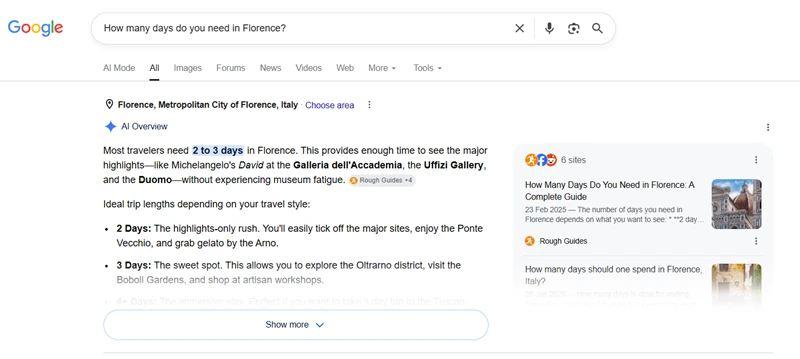
Instead of showing only regular search results, Google may create a short answer saying that 2 to 3 days are enough for a first trip.
This is useful for the traveler, but it changes the way people find travel content.
Before, your post mainly competed with other blog posts and websites. Now, it may also appear near, below, or inside an AI-generated answer. So your content needs to be easy to understand quickly, both for people and for search systems.
What is AEO?
AEO stands for answer engine optimization.
It simply means writing content that answers questions clearly.
For travel bloggers, this often means moving from broad topics to more specific travel questions. So, instead of only writing around a topic like “Florence travel guide,” you can build sections or posts around questions like:
- How many days do you need in Florence?
- Is Florence worth visiting for 2 days?
- Where should you stay in Florence for a first trip?
- Can you visit Florence without a car?
These questions are useful because they match how people plan trips. They are not just browsing. They are trying to make a decision.
AEO does not mean your writing has to feel robotic. It just means the answer should not be buried too far down the page.
What is GEO?
GEO stands for generative engine optimization.
It focuses on making your content easier for AI tools to understand, summarize, and reference. These tools may include AI search engines, chatbots, and AI features in search results.
For a travel blog, this usually comes down to clarity and trust.
Your post should make it easy to understand:
- what question you are answering
- who the advice is for
- what you recommend
- what details come from your own trip
- what information comes from official or updated sources
- what trade-offs readers should know before they decide.
For example, “Venice is crowded in summer” is true, but it is also very generic.
This is more useful: “Venice feels much calmer early in the morning, especially before day-trippers arrive. If you stay overnight, you can enjoy places like Rialto Bridge and Piazza San Marco before the busiest hours.”
You do not need to worry too much about the labels. AI Overviews, AEO, and GEO all point in a similar direction for travel bloggers: answer the question clearly, write from real experience, and make your advice easy to find.
Now that the main terms are clear, let’s look at the types of travel questions where AI Overviews are more likely to appear.
What travel questions are more likely to trigger AI Overviews?
Travel is full of searches where people want a quick, clear answer before they book, plan, or change a trip.
A broad search like “Florence travel guide” can mean many things. The person may want attractions, hotels, food, weather, transport, costs, or a full itinerary. But a question like “How many days do you need in Florence?” has a clearer purpose. The person wants help making a decision.
Here are common travel question types that can work well for AI Overview-friendly content:
| Query type | Example | What the traveler wants |
|---|---|---|
| Worth-it questions | Is Milan worth visiting for 2 days? | A quick yes/no answer with context |
| Itinerary questions | How many days do you need in Porto? | A realistic trip length |
| Timing questions | What is the best time to visit Plitvice Lakes? | Weather, crowds, and seasonal tips |
| Comparison questions | Florence or Bologna for food? | Help choosing between two options |
| Transport questions | Can you visit Lake Como without a car? | Practical route advice |
| Stay questions | Where to stay in Rome for a first trip? | Area recommendations |
| Budget questions | Is Copenhagen expensive for tourists? | Realistic cost expectations |
| Safety questions | Is Naples safe for solo female travelers? | Honest, balanced advice |
These questions may not always have a huge search volume. However, they often match real planning moments.
Someone searching “Croatia travel” may only be browsing. But someone searching “can you visit Plitvice Lakes without a car?” is probably closer to planning an actual trip.
That is why question keywords matter for travel bloggers. A broad keyword gives you a topic. A question gives you an angle. For example:
- Broad keyword: Rome itinerary
- Better question: How many days do you need in Rome for a first trip?
- More specific angle: Is 3 days in Rome enough if you want to visit the Vatican too?
You do not need a separate post for every tiny question. That would quickly become messy. Instead, group related questions inside one useful guide when they naturally belong together.
For example, a post about visiting Venice in October could answer:
- Is October a good month to visit Venice?
- Is Venice crowded in October?
- Does Venice flood in October?
- What should you wear in Venice in October?
- Is Venice expensive in October?
This makes the post more complete without turning your blog into a pile of short, repetitive articles.
If you want to plan these related questions more strategically, keyword clustering can help. It shows you which travel questions belong together, which ones deserve separate posts, and how to build stronger topical authority over time. I explain the full process in this guide on keyword clustering for travel blogs.
How to structure travel posts for AI Overviews
A good travel post should make the main answer easy to find. The article can still be detailed, but readers should understand your advice early.
Start with the direct answer
If your post targets a question, answer that question near the beginning.
Example:
Question: “Can you visit Lake Como without a car?”
Direct answer: “Yes, you can visit Lake Como without a car, especially if you stay near a train station or ferry stop. It works well for a relaxed trip to towns like Como, Bellagio, Varenna, or Menaggio. However, it can feel slow if you try to visit too many places in one day.”
After that, you can explain the details:
- where to stay without a car
- which towns are easiest to reach
- how the ferries work
- when train travel makes sense
- what feels realistic in one day
- what you would do differently next time.
Build the post around the answer
Once you give the quick answer, the rest of the post should support it.
For a post about visiting Lake Como without a car, you might structure it like this:
| Section | What it should cover |
|---|---|
| Quick answer | Whether Lake Como works without a car |
| Who this advice is for | First-timers, slow travelers, couples, or train travelers |
| Best bases | Towns that work well without a car |
| Transport options | Trains, ferries, buses, and walking |
| 1-day route | What to prioritize if time is limited |
| 2-day route | A slower plan with more flexibility |
| Common mistakes | Trying to fit in too many towns, ignoring ferry times, or staying too far from transport |
| Personal tips | What worked, what felt slow, and what you would change |
| FAQs | Short answers to related planning questions |
This keeps the post focused instead of turning it into a general destination guide.
Use question-style headings when they feel natural
Question-style headings can make your post easier to scan because they match how people search. Instead of only using headings like “Getting around” or “Where to stay,” you can use headings such as:
| Generic heading | More useful heading |
|---|---|
| Best time to visit | When is the best time to visit Florence? |
| Getting around | Can you visit Florence without a car? |
| Where to stay | Where should you stay in Florence for a first trip? |
| Day trips | What are the best day trips from Florence? |
| Budget tips | Is Florence expensive for tourists? |
You do not need every heading to be a question because too many question headings can feel forced. So, use them where they make the section clearer.
Add a quick summary near the top
A short summary near the top can help readers decide if the post matches their trip. This works especially well for destination guides, itinerary posts, comparison posts, and “is it worth visiting” articles.
Example:
Quick answer: is Bologna worth visiting?
- Best for: food, porticoes, local atmosphere, easy train trips
- How many days: 2 days for the city, 3 days with a day trip
- Best time to go: spring or fall
- Good for first-timers: yes, especially if you want a less touristy Italian city
- Main downside: fewer “must-see” landmarks compared to Florence or Rome
This gives readers a fast overview without removing the deeper content. After that, your full post can explain each point with more detail, photos, and personal advice.
Use tables for comparisons and quick decisions
Tables work well when readers need to compare options quickly. They work well for posts about destinations, neighborhoods, itineraries, transport choices, seasonal travel advice, and budget breakdowns.
Florence vs Bologna: quick comparison
| Category | Florence | Bologna |
|---|---|---|
| Best for | Art, museums, Renaissance architecture | Food, local life, porticoes |
| First-time Italy trip | Better choice | Better second-trip choice |
| Crowds | Very crowded in peak season | Busy, but usually calmer |
| Food scene | Great, but touristy in the center | Excellent and easier to enjoy casually |
| Day trips | Pisa, Siena, Lucca | Modena, Parma, Ravenna |
Tables like this help readers compare options quickly, especially when they are planning on a phone.
How to add first-hand travel experience
First-hand experience is one of the strongest things you can add to a travel post. It does not need to be a long personal story. In fact, it often works better when it is short, specific, and useful.
For example, this is generic: “Visit the Duomo early to avoid crowds.”
This is stronger: “When I visited Florence in June, the area around the Duomo was already busy by 9 a.m. If you want quieter photos, go before breakfast or later in the evening when many day-trippers have left.”
The second version gives readers more to work with. It tells them when you visited, what the place was like, and how they can plan around it.
You can add first-hand experience by mentioning things like:
- the month or season of your visit
- what felt easier or harder than expected
- how long something actually took
- what you would skip next time
- what you would book in advance
- where you got confused
- what surprised you
- what type of traveler the place is best for
- what your photos show that the text cannot fully explain.
The key is to turn your experience into advice.
For example:
Too personal without enough value: “We arrived in Seville tired after a long train ride, checked into our hotel, and walked around the center for a while before deciding what to do.”
More useful for the reader: “After arriving in Seville by train, I would avoid planning too much on your first afternoon. Santa Justa station is not far from the center, but checking in, freshening up, and walking in the heat can take more energy than expected.”
This matters because many travel questions are not only about facts. People also want to know what the experience feels like:
- Was the train route simple?
- Did the viewpoint feel worth the climb?
- Was the old town still lively in the evening?
- Did the famous attraction feel too crowded to enjoy?
- Was the “hidden gem” actually worth the detour?
These are the kinds of details that make your content more helpful than a basic summary.
Also, don’t be afraid to be honest. Not every place needs to sound perfect. If something disappointed you, explain why. If a destination is beautiful but difficult without a car, say that clearly. Or, if a popular attraction is still worth visiting despite the crowds, explain how to make it easier.
For example: “Lake Como is beautiful without a car, but it can feel slow if you want to visit several towns in one day. Ferries are scenic and easy to use, but you need to check the schedule carefully, especially outside peak season.”
That kind of advice feels useful because it has nuance. It helps readers decide if the trip fits their time, budget, and travel style.
How to use sources in travel content
Your own experience gives the post personality. Sources help keep the practical details accurate.
You don’t need to cite a source for every opinion. If you say a viewpoint felt crowded at sunset, that can come from your own trip. But when you mention details that can change, use a reliable source. This includes things like ticket prices, tourist taxes, and entry rules. Official sources are usually the safest choice for these details (see table below).
| Source type | Best for |
|---|---|
| Official tourism boards | Destination facts, attractions, events |
| Museum and attraction websites | Tickets, opening hours, booking rules |
| Public transport websites | Routes, schedules, passes, disruptions |
| Government websites | Visa rules, safety guidance, entry requirements |
| Weather services | Seasonal weather patterns |
| Local city websites | Tourist taxes, local rules, public services |
| Reputable travel studies | Tourism trends, visitor numbers, travel behavior |
That does not mean your post needs to sound like a school report. A source should support your advice, not take over your voice.
So, instead of writing, “According to the official tourism website, the museum opening hours are from 9 a.m. to 7 p.m. Therefore, visitors should verify this information before arrival,” keep it more natural: “The museum usually opens during the day, but check the official website before you go because hours can change by season, holidays, or special events.” This still points readers to the source, but it sounds like travel advice rather than a formal report.
For example:
“The fastest high-speed trains from Bologna to Florence take around 40 minutes. For me, Bologna feels easier for a relaxed food-focused trip, while Florence makes more sense if this is your first time in Italy and you want famous art and architecture.”
The train time is a fact. The city comparison is your opinion. Both are useful, but they do different jobs.
You should also update source-based details regularly. Prices change. Routes change. Attractions add reservation systems. Local rules shift.
You do not need to refresh every post every month. But if an older guide still gets traffic, check the details that could affect someone’s trip. A short “last updated” note can help readers trust the guide more, especially when the post includes prices, transport, or booking advice.
How images, captions, and schema support AI visibility
Travel posts are visual, but images should do more than decorate the page.
A good image can support your advice, show first-hand experience, and help readers understand what a place is really like. For example, a photo of Rialto Bridge is nice. But a photo of Rialto Bridge with a caption saying it was taken early in the morning before the busiest crowds gives readers useful planning context.
Also, use captions when they help readers notice something useful, such as crowd levels, walking conditions, seasonal details, or what makes a place easier to visit. If the image is only decorative, keep the caption short or skip it.
Photos can support many types of travel advice. You can use them to show:
- crowd levels
- viewpoints
- walking routes
- hotel areas
- train stations, ferry stops, or bus stops
- beaches, hikes, or scenic spots
- food markets and local dishes
- seasonal conditions.
File names and alt text also matter. A file name like IMG_4839.jpg does not say much. A file name like rialto-bridge-early-morning-venice.jpg gives more context. Alt text should describe the image clearly and naturally.
For example: “Early morning view of Rialto Bridge in Venice before the busiest day-tripper hours.” That is more useful than “Venice bridge” because it explains what is in the image and why it matters.
I won’t go too deep into alt text here because I already wrote a full guide on this topic. You can read it here: how to write alt text for travel photos.
Schema can also help search engines understand your page better.
For travel bloggers, useful schema types may include Article schema, Breadcrumb schema, FAQ schema, Image schema, Video schema, or Review schema when it truly fits the content.
For example, if your post has a real FAQ section, FAQ schema can help search engines understand those questions and answers more clearly. But do not add schema just because it sounds good for SEO. Schema should describe what is already visible on the page.
So:
- do not add FAQ schema if the page does not have visible FAQs
- do not use HowTo schema for a loose travel story
- do not use Review schema unless the content is actually a review.
I explain this in more detail here: how to use schema markup for travel content.
A simple way to think about it: if an image, caption, or schema markup helps a real traveler understand the page better, it probably helps search engines understand it too.
Before and after: a better AI-friendly travel answer
Sometimes the easiest way to improve a travel section is to check whether it answers the real question.
A lot of travel content is not wrong. It is just too broad.
Let’s say you want to answer this question: Is Bologna worth visiting?
A weaker answer might look like this: “Bologna is a beautiful city in northern Italy with a rich history, many attractions, and delicious food. It is known for its porticoes, university, towers, and traditional dishes. Many travelers visit Bologna while exploring Italy because it offers a different atmosphere from other famous cities.”
This is clear, but it feels generic. You could change the city name, adjust a few landmarks, and use the same paragraph for many places in Italy.
A stronger answer would be: “Yes, Bologna is worth visiting if you love food, walkable cities, local atmosphere, and easy train trips. It is a great choice if you have already seen Italy’s most famous cities or want a less crowded base between Florence, Venice, and Milan. However, if this is your first trip to Italy and you only have a few days, Florence or Rome may feel more impressive.”
The second version works better because it gives a clear answer right away. It also explains who Bologna is best for and adds an honest limitation. That is what makes the advice more useful.
When a section feels too generic, try this simple pattern: Direct answer + who it is for + useful context + honest limitation.
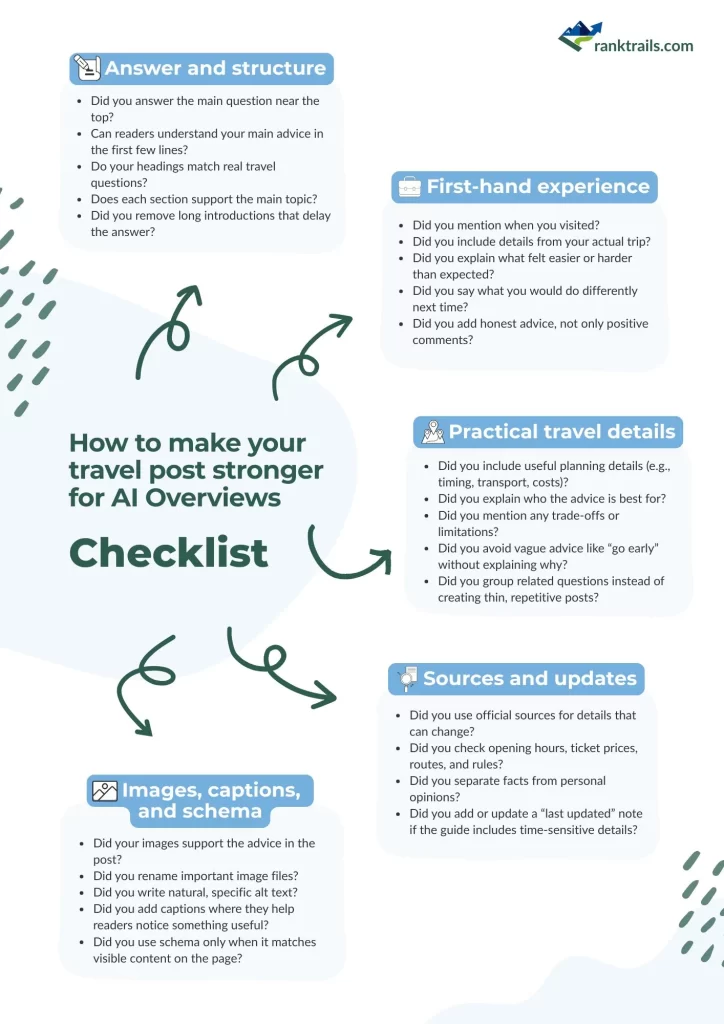
Want an easier way to review your travel posts before publishing? Download the free travel AI Overviews checklist and use it to check whether your article has a clear answer, useful first-hand experience, practical travel details, updated sources, and image optimization basics.
FAQs about writing travel content for AI Overviews
FAQs can support AI Overview optimization, but only when they answer real follow-up questions. A good FAQ section should answer what the reader may still wonder after reading the post.
Search the keyword manually and look at the results page. Check whether Google shows an AI Overview, a featured snippet, a People Also Ask box, videos, forums, or Reddit threads. These results can show you what kind of answer Google thinks the searcher wants.
For example, if you search “Can you visit Lake Como without a car?” and see many question-based results, the topic likely needs clear, practical advice.
For a deeper process, you can read my guide on finding travel SEO keywords that still get clicks in AI search.
Answer the question clearly, then use related phrases naturally. For example, if your main keyword is “how many days in Seville,” you may also mention “2 days in Seville,” “3 days in Seville,” “Seville itinerary,” or “how long to stay in Seville” where they fit.
Do not repeat the same phrase in every heading or paragraph. It makes the copy harder to read, and it does not help the reader.
Yes, but use them as an assistant. AI tools can help you brainstorm angles, organize sections, improve structure, or rewrite unclear paragraphs. But your real trip should lead the post.
Start with Google Search Console. Look at impressions, clicks, click-through rate, average position, and question-style queries for your important posts. If impressions stay stable but clicks drop, search the main query manually. An AI Overview, featured snippet, People Also Ask box, video result, or forum thread may be answering part of the question before readers click.
Conclusion
Writing travel content for AI Overviews does not mean stripping the personality out of your blog. It means making your best advice easier to understand.
Start with the answer your reader came for. Then add the details that make your post worth reading: what you noticed, what helped, what felt confusing, what you would skip, and what you would happily do again.
That mix of clear answers and real experience is what makes a travel post useful. It helps readers make better decisions, and it gives your content a better chance of standing out in AI search.