You open Google Search Console expecting the usual pattern: rankings stable, impressions steady, clicks following along. Instead, impressions increase while traffic drops.
A few years ago, many travel bloggers would have treated this as a clear SEO problem. In 2026, it may simply reflect how search works.
AI Overviews, maps, hotel widgets, and featured snippets answer more travel questions directly in search results. Travelers can compare destinations, check costs, or decide when to visit without opening a website.
That shift created a lot of uncertainty. Some bloggers assume SEO is dying. Others worry every traffic decline means something went wrong. But the reality is less dramatic.
Travel SEO still works, but not every keyword serves the same purpose anymore. Some topics now build visibility, while others still generate clicks, affiliate revenue, and bookings.
In this guide, you’ll learn:
- why travel traffic is changing
- which travel keywords still have strong click potential
- how to identify searches less affected by AI Overviews
- why impressions sometimes matter as much as clicks
- how to measure SEO performance more realistically in 2026.
Because the question for many travel blogs is no longer simply: “Can I rank?”
Increasingly, it becomes: “If I rank, will travelers still click?”
Table of Contents
Why is travel blog traffic changing in 2026?
If you started blogging before AI Overviews appeared, you may remember when ranking in the top three positions often meant steady clicks. Search results looked simpler. Someone searched “best things to do in Rome”, opened several articles, compared recommendations, and started planning a trip.
Today, travel searches often include much more than organic results. These extra elements are often called SERP features, meaning search result features that appear around traditional blue links:
- AI Overviews
- maps
- hotel listings
- flight modules
- featured snippets
- videos
- People Also Ask sections
- destination panels.
In some cases, users see answers, prices, and recommendations before reaching traditional website links. Organic results still appear, but they compete for attention in a busier environment. And travel is particularly affected because many searches involve practical questions:
- What’s the weather like?
- How expensive is this destination?
- How many days do I need?
- What should I visit?
Search engines increasingly answer those questions directly. That doesn’t necessarily reduce demand for travel content. Instead, travelers may reach websites later, once they start comparing accommodation, organizing transport, or building itineraries.
Someone researching Madeira, Portugal, in March, April, and May, for example, might first look for quick information. Later, the same person may search for routes, neighborhood guides, or budget estimates before making decisions.
As a result, rankings alone often explain less than they used to. A page can rank well and receive fewer clicks. Another may rank lower but attract readers who spend longer planning or comparing options.
Search behavior changed, which also changed how traffic behaves.
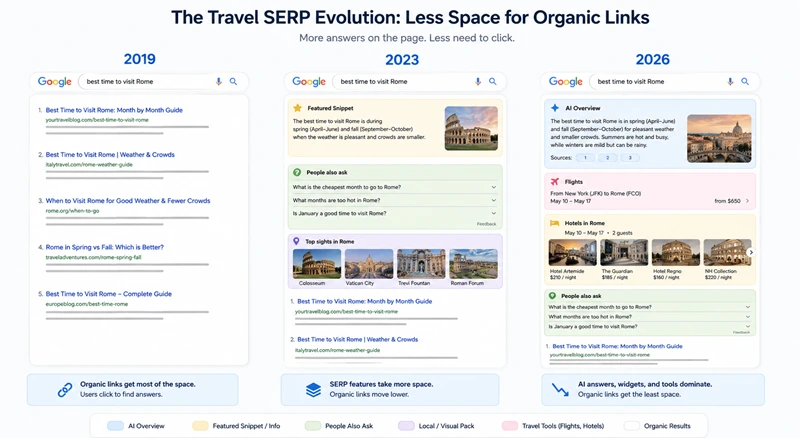
The rise of AI Overviews in travel search
Not every travel search is equally affected by AI Overviews. Some queries are much easier for AI to answer than others. Think about searches like:
- best time to visit Japan
- is Venice expensive
- how many days in Vienna.
These questions often have broad or fairly predictable answers. AI can summarize average temperatures, tourist seasons, costs, or popular attractions in a few sentences, so users may get enough information without opening a website.
Now compare those with:
- 7 day Dolomites itinerary without car
- Lake Garda vs Lake Como for couples
- Milan airport to city center train options.
Travelers searching these topics usually need routes, comparisons, logistics, opinions, or updated recommendations. As a result, they may open several sources before deciding.
Planning depth often changes click behavior. The more specific the search becomes, the harder it is for a short AI summary to replace detailed content. Broad patterns start to appear (see table below).
| Search intent | Example searches | AI Overview risk | Why |
|---|---|---|---|
| Broad inspiration | best beaches in Spain, things to do in Copenhagen | High | AI can summarize popular attractions or ideas quickly. |
| Simple factual questions | what currency does Albania use, is Slovenia expensive | High | Users often need one short answer. |
| Early trip research | where to stay in Sicily, Portugal in winter | Medium–high | AI can give a starting point, but users may still compare options. |
| Comparisons | Lake Garda vs Lake Como, Florence or Bologna | Medium | AI can summarize differences, but personal preferences still matter. |
| Logistics | Milan airport to city center train, bus Dubrovnik to Kotor | Low–medium | Users need current routes, prices, and details. |
| Detailed planning | 5 day Dolomites itinerary without car | Low | A short AI answer rarely covers routes, timing, and trade-offs well. |
| Commercial decisions | best eSIM for Italy, travel insurance for Japan | Low | Users usually compare products, prices, and trust signals before buying. |
As you can see, broad informational topics are easier to summarize and planning-heavy searches are harder to compress into one answer. That creates different opportunities depending on the type of content you publish.
So, the challenge for travel bloggers is learning to recognize those differences before investing time into a topic. And that’s where keyword classification becomes useful.
Visibility-driven vs traffic-driven keywords
For years, many bloggers judged keyword success using one question: “Did this topic generate clicks?” That approach made sense when rankings and traffic were closely connected.
Today, a keyword can appear thousands of times in search results and still bring relatively few visits. Meanwhile, another keyword with lower impressions may generate engaged readers, affiliate clicks, or bookings. This doesn’t automatically mean one performs better than the other. They may simply serve different purposes.
Therefore, thinking about keywords in two groups can make travel SEO easier to understand:
- visibility-driven keywords
- traffic-driven keywords.
Visibility-driven keywords
Visibility-driven keywords mainly support awareness and discovery.
These searches often happen early in the traveler journey, when someone is researching ideas rather than making decisions. For example, a query like “best time to visit Iceland” may help travelers discover your blog, even if they don’t click immediately.
These topics may trigger AI Overviews or other SERP features. Therefore, users sometimes get enough information without clicking, but that doesn’t make the content useless.
Visibility-focused topics can help:
- increase impressions
- strengthen topical authority, meaning your blog covers a destination or topic deeply enough to be seen as a useful source
- introduce your blog to new audiences
- support future branded searches
- build destination coverage over time.
Traffic-driven keywords
Traffic-driven keywords serve a different role. These are travel searches that still encourage users to click because they need details, comparisons, logistics, or booking help. For example, a query like “7 day Portugal itinerary” is more likely to attract someone who wants practical planning help.
These searches often require:
- planning
- comparing options
- organizing transport
- evaluating accommodation
- preparing to spend money.
Users still click because short answers rarely solve the entire problem.
Traffic-driven topics are more likely to support:
- pageviews
- affiliate revenue
- newsletter signups
- bookings
- conversions.
The same metric doesn’t fit every keyword
Imagine two blog posts: article A and article B.
| Article A | Article B |
|---|---|
| Keyword: Best time to visit Croatia Results after six months: 40,000 impressions 400 clicks | Keyword: Croatia itinerary 7 days Results after six months: 6,000 impressions 1,200 clicks |
If you only look at traffic, Article B appears stronger. If you only look at visibility, Article A looks more successful. Neither conclusion tells the full story.
The more useful question is: What was this content supposed to achieve?
Once you start separating keyword roles, reporting becomes easier to interpret.
Example: classifying keywords before writing
Before choosing a topic, it helps to assign each keyword a role. For example, a Croatia travel blog could organize keywords like this:
| Keyword | Main role | Why |
|---|---|---|
| best time to visit Croatia | Visibility | Broad question that AI can summarize easily. |
| Croatia itinerary 7 days | Traffic | Travelers need routes, timing, and planning details. |
| where to stay in Plitvice | Traffic | Users compare areas before booking accommodation. |
| Croatia travel budget | Planning support | Cost questions need examples, ranges, and context. |
| best hotels near Plitvice Lakes National Park | Conversion | Users are close to making a booking decision. |

This makes content planning and reporting clearer. A visibility keyword may succeed through impressions and branded searches, while a traffic or conversion keyword should be judged more by clicks, engagement, affiliate clicks, or bookings.
Why impressions matter more than clicks sometimes
Many travel bloggers open Google Search Console, notice falling clicks, and immediately assume something is wrong. Sometimes they’re right, but sometimes they aren’t.
Imagine this scenario: your article about “things to do in Bologna” had the following stats.
| 2024 | 2026 |
|---|---|
| 15,000 impressions 900 clicks | 35,000 impressions 450 clicks |
At first glance, the numbers look negative because traffic dropped. However, something else also happened: the article appeared in search results much more often. Search behavior changed, but your content did not necessarily lose relevance. This is why impressions deserve more attention than many bloggers give them.
Impressions can signal:
- growing topical authority
- stronger destination coverage
- increased brand exposure.
They don’t replace clicks. Instead, they provide additional context.
Clicks still matter, but context matters too
A drop in clicks deserves investigation when:
- rankings declined significantly
- competitors replaced you
- CTR, or click-through rate, dropped unexpectedly
- content became outdated
- traffic-driving keywords lost visibility.
CTR shows how often people click your result after seeing it in search. However, lower CTR may happen even when rankings remain stable because search results contain:
- AI Overviews
- featured snippets
- videos
- maps
- booking modules.
The page competes for attention in a different environment.
| Metric | Possible interpretation | Reality |
|---|---|---|
| High impressions + low clicks | Content failed | Topic may primarily support visibility |
| Stable rankings + lower CTR | SEO issue | SERP features may reduce clicks |
| Lower sessions | Content lost relevance | Search behavior may have changed |
| Rising branded searches | Random growth | Earlier visibility may influence recognition |
Lower clicks don’t always point to a content problem. Impressions, CTR, and visibility trends can help explain why performance changes.
Which travel keywords still generate traffic?
If broad informational searches increasingly trigger AI Overviews, where do clicks still happen?
Travelers are more likely to click when they need help planning, comparing options, organizing logistics, or making decisions. So, topics requiring detail tend to keep stronger click potential.
| Traffic opportunity | Example searches | Why users still click | Best content format |
|---|---|---|---|
| Detailed itineraries | 7 day Portugal itinerary, 5 day Dolomites itinerary without car | Travelers need routes, timing, budgets, and realistic planning notes. | Day-by-day itinerary, map, downloadable PDF |
| Logistics and transport | Venice airport to city center, public transport in Ljubljana | Users need updated steps, prices, schedules, and alternatives. | Transport guide, comparison table, FAQ |
| Destination comparisons | Florence or Bologna, Madeira vs Tenerife | Travelers want help choosing based on trip style, budget, weather, and interests. | Pros/cons table, decision guide |
| Commercial travel tools | best eSIM for Italy, travel insurance Japan | Users are close to spending money and need comparisons. | Product roundup, comparison table, affiliate guide |
| Downloadable resources | Italy packing list PDF, Barcelona itinerary map | Travelers want something practical to save, print, or use during the trip. | Checklist, printable guide, Google Map |
| Accommodation planning | where to stay in Bologna, best neighborhoods in Lisbon | Users compare areas before booking. | Neighborhood guide, map, hotel recommendations |
| Budget planning | budget for 7 days in Iceland, how much money for Japan trip | Cost questions need examples, ranges, and real planning context. | Budget breakdown, sample expenses, calculator |
Content upgrades that make traffic-driven keywords more useful
Traffic-driven keywords often work better when the article includes something travelers can save or use while planning. For example:
- A 7-day Portugal itinerary can include a downloadable day-by-day PDF.
- A where to stay in Bologna guide can include a simple neighborhood map.
- A Japan trip budget article can include a sample expense tracker.
- A Dolomites without a car guide can include a public transport checklist.
- A Florence or Bologna comparison post can include a decision table.
These extras can improve engagement, support email signups, and help readers return to the page later.
How MOFU and BOFU keywords support travel traffic
Another way to understand traffic potential is to look at where the traveler is in the planning journey.
Not every travel query reflects the same level of search intent. Someone searching “best places to visit in Italy” is exploring ideas, while someone searching “best hotels in Bologna city center” is closer to booking.
Funnel stages (TOFU, MOFU, and BOFU) describe where someone is in the planning journey. TOFU means they are exploring ideas, MOFU means they are comparing options, and BOFU means they are closer to making a decision.
| Funnel stage | Traveler mindset | Example searches | Main role | Click potential |
|---|---|---|---|---|
| TOFU (Top of funnel) | “I’m exploring ideas.” | things to do in Sicily, best places in Croatia | Inspiration and awareness | Lower |
| MOFU (Middle of funnel) | “I’m comparing options.” | 7 day Sicily itinerary, where to stay in Dubrovnik | Planning and comparison | Medium–high |
| BOFU (Bottom of funnel) | “I’m ready to decide.” | best hotels in Lake Garda, Italy eSIM comparison | Booking or purchase | High |
Travel blogs often lean heavily toward TOFU content because inspiration topics tend to have larger search volumes. These posts can still build visibility and destination coverage. However, MOFU and BOFU keywords usually have stronger click potential because travelers need details, comparisons, reassurance, or booking help.
How to identify non-AI Overview keywords
There isn’t a fixed list of keywords that always avoid AI Overviews. Search results change constantly. A keyword with clean organic results today may trigger AI summaries later. Because of that, finding opportunities depends less on rules and more on understanding search behavior.
- Start with a broad topic, then narrow the intent
Instead of researching only “Italy travel”, explore more specific angles:
– Italy packing list
– train travel in Italy
– best eSIM for Italy
– northern Italy without a car.
Specific intent often reveals stronger click opportunities.
In addition, these more specific searches are usually long-tail keywords, and they often reveal clearer travel intent. If you need a deeper process for finding them, read my guide to long-tail keyword research for travel blogs. - Check the actual search results
Before choosing a keyword, search it manually. Look for:
– AI Overviews
– featured snippets
– videos
– maps
– hotel widgets
– forums
– mostly organic results.
SERPs often tell you more than search volume alone. A keyword with moderate volume but fewer SERP features may attract better traffic than a high-volume topic dominated by AI answers. - Look beyond search volume
High volume doesn’t always mean strong traffic potential. And lower-volume keywords sometimes attract more engaged readers because the intent is more specific.
- Prioritize planning and decision-stage searches
When evaluating a topic, ask: “Does the traveler need to compare, organize, budget, or decide something?” Keywords related to planning, accommodation, budgeting, transport, packing, comparisons, and bookings often keep stronger click potential.
- Recheck keywords over time
Performance doesn’t stay static. Search behavior changes, new SERP features appear, and AI Overviews expand into different topics. Reviewing important keywords periodically can help spot shifts before traffic declines.
Useful tools for this process
Keyword tools remain helpful, but manual SERP checks matter more than before. For a more complete workflow, you can also read my guide to travel blog keyword research using SEO and AI tools.
Useful options include:
- Google Search Console → identify pages gaining impressions but losing CTR
- SEMrush → explore keyword intent and SERP features
- Ahrefs → compare keyword difficulty and ranking patterns
However, none replace looking at search results yourself.
How should travel bloggers measure SEO success in 2026?
If search behavior changes, reporting should change too. Many bloggers still review performance using one metric: organic traffic.
And yes, traffic matters. However, sessions alone rarely explain the full picture. A broad destination guide and a detailed itinerary may rank for similar topics while serving different purposes. So, measuring both the same way can make reporting harder to interpret.
That’s why thinking in content roles can make reporting clearer.
Content focused on visibility
These metrics often make more sense over longer periods rather than month-to-month fluctuations.
| Helpful metric | What it may indicate |
|---|---|
| Impressions | More travelers see your blog in destination-related searches. |
| Branded searches | People search for your blog name, website name, or specific content after seeing you in search results. |
| SERP feature presence | Your content appears near AI Overviews, snippets, maps, videos, or other rich results. |
| Destination/topic coverage | Your blog is building authority around a destination, route, or travel topic. |
Content focused on traffic or conversions
These metrics may benefit from more frequent monitoring, especially after updates or seasonal changes.
| Helpful metric | What it may indicate |
|---|---|
| Organic sessions | Travelers visit the post from search. |
| CTR | People choose your result after seeing it in the SERP. |
| Engagement | Readers spend time comparing options, planning routes, checking costs, or reading recommendations. |
| Affiliate clicks | Readers click hotel, tour, eSIM, insurance, or travel product links. |
| Downloads or saves | Readers download maps, save itineraries, print packing lists, or use checklists. |
| Conversions | Readers sign up for your newsletter, click booking-related links, download resources, or take another goal action. |
Common reporting mistakes travel bloggers make
SEO reports have become easier to misread because search behavior changed faster than many reporting habits.
One common mistake is treating every article the same. A broad destination guide and a detailed itinerary may both support your blog, but they should not use the same KPIs. A destination guide may build impressions and topical authority, while an itinerary may generate clicks, downloads, affiliate revenue, or bookings.
Another mistake is assuming lower clicks always mean the content stopped working. Sometimes, AI Overviews, maps, videos, featured snippets, or hotel widgets simply change how users interact with search results.
Many travel blogs also rely heavily on inspiration content:
- things to do in…
- best places to visit…
- when to travel…
These topics still have value. However, relying mostly on awareness-stage content may make traffic growth harder as AI answers more broad informational searches.
Traffic also doesn’t always show usefulness. So, depending on the content type, it may help to monitor:
- newsletter signups
- map downloads
- itinerary saves
- outbound hotel clicks
- printable downloads
- average engagement time.
Someone spending 10 minutes planning a trip may be more valuable than several quick visits.
Finally, avoid reacting too quickly to incomplete data. Performance drops may come from outdated content, changing search intent, stronger competitors, or SERP changes. Trends usually give a clearer picture.
FAQs about travel SEO in 2026
Yes. Personal experience can make travel content more useful, especially when it adds details AI summaries often miss. For example, explain what felt crowded, what was hard to plan, which transport option worked best, or what you would do differently. These details can make your content more trustworthy and harder to replace with generic summaries.
Start by checking whether rankings dropped, CTR declined, or the SERP changed. If AI Overviews or other features now answer the query directly, update the post with more specific planning value. Add comparisons, current prices, transport details, maps, FAQs, or downloadable resources. If the topic is too broad, link it to more traffic-focused supporting posts.
No. A broad destination guide may help travelers discover your blog, while an itinerary, hotel guide, or transport post may drive more clicks and conversions. Before writing, decide whether the post should build visibility, support planning, or help readers make a booking decision.
Keyword clusters help you organize related travel searches by destination, intent, and planning stage. This makes it easier to combine visibility-driven topics with traffic-driven ones. For example, a broad topic like “Croatia travel” can support topical authority, while related posts about “7 day Croatia itinerary,” “where to stay in Plitvice,” or “Croatia travel budget” can target readers who are closer to planning or booking. This balance helps your blog stay visible in AI-heavy search results while still creating content that deserves a click. You can read more in my guide to keyword clustering for travel blogs.
In conclusion, travel SEO isn’t disappearing. The rules are changing.
AI Overviews, richer SERPs, and zero-click searches make some travel topics harder to monetize through traffic alone. Broad informational keywords may still build visibility, but they may not always bring clicks.
That does not mean travel blogs have fewer opportunities. Travelers still compare destinations, save itineraries, check budgets, organize transport, and look for practical advice before making decisions.
So, before creating new content, ask:
- What role will this keyword play: visibility, planning support, or conversion?
- Will travelers still need to click for the answer?
- Does the topic require comparison, logistics, budgeting, booking help, or personal experience?
- Which metric should measure success: impressions, CTR, clicks, affiliate clicks, downloads, or conversions?
The main takeaway: stop judging every travel keyword by clicks alone. In 2026, some keywords help travelers discover your blog, while others drive traffic, affiliate revenue, and bookings. So, a strong travel SEO strategy needs both.