Search is evolving faster than ever. AI tools, featured snippets, and zero-click results are reshaping how travelers find information and how bloggers need to think about visibility. Ranking isn’t just about picking high-volume keywords anymore; it’s about understanding how AI systems interpret and surface answers.
For travel bloggers, that shift is huge. Your content now competes not only with other sites but also with AI-generated summaries that often appear above traditional organic results. To stay visible, you need a keyword research process that combines solid SEO foundations with modern, AI-aware thinking.
In this guide, you’ll learn an 8-step process tailored specifically for travel bloggers who already know their topic — like hiking in Capri, Italy — and want to identify the best keywords to reach the right readers and appear in both search results and AI Overviews.
This approach bridges data, intent, and creativity — helping your travel blog stand out in a search landscape where understanding how people search is just as important as what they search for.
Table of Contents
What is keyword research and how does it shape your travel blog’s visibility
Keyword research is the process of finding and analyzing the exact words and phrases travelers use when they search online. It’s what connects what people want to find with what you want to share.
It’s the difference between a post that quietly sits in your archive and one that shows up when someone types “best hikes in Capri” or “where to stay near Arco Naturale.”
For travel bloggers, keyword research isn’t just about SEO — it’s about understanding the traveler’s search journey. Each query reveals intent: dreaming, planning, or booking. When your content aligns with that intent, Google recognizes it as relevant, and your post reaches the right audience at the right moment. This alignment with intent directly reflects what Google emphasizes in its Search Quality Rater Guidelines and Helpful Content updates — rewarding pages that genuinely help users rather than those optimized only for search engines.
The keyword research process below is part of a modern framework I’ve developed and been testing across different niches through my work as an SEO specialist. It blends traditional keyword research techniques with AI-inspired methods that reflect how search and content discovery are evolving today.
The 8-step process at a glance
Here’s a quick overview of the steps you’ll follow in this keyword research process that you can easily apply to any travel topic:
- Define your post’s search intent – understand what travelers want when they search your topic.
- Explore topic trends and related questions with Perplexity – find fresh angles and natural long-tail ideas.
- Simulate traveler searches with ChatGPT – uncover how real people might phrase their queries.
- Evaluate keyword data with SEMrush (or another SEO tool) – check search volume, difficulty, trend, and intent.
- Validate keywords through AI Overview results – confirm that your keywords align with Google’s current interpretations.
- Cluster related keywords – group similar terms to structure your blog logically and avoid overlap.
- Select one primary keyword and supporting ones – give your post a clear focus and natural keyword hierarchy.
- Add LSI keywords for depth – enrich your copy with semantically related terms for better topical coverage.
How to do keyword research for your travel blog (step by step)
Here’s how to take the travel idea — hiking in Capri — or any other, and turn it into a post travelers can actually find on Google.
1. Define your post’s search intent
First, before diving into tools, take a moment to clarify what travelers are looking for when they search your topic.
Take the keyword “hiking in Capri.” Each part of this phrase already hints at what searchers want:
- “Hiking” suggests an activity-focused search — people want routes, difficulty levels, or experiences, not commercial offers.
- “In” indicates a location-based intent — the user is exploring what can be done in a specific place.
- “Capri” signals destination intent — they’re looking for insights tied to that particular island, not general hiking advice.
Put together, it clearly shows an informational intent: travelers want trail details, maps, viewpoints, and local tips — not booking options or gear recommendations. Understanding that purpose helps you choose the right keywords and structure your content accordingly.
Need help identifying different types of search intent and how they shape travel content? Check out this guide on search intent and the traveler’s search journey.
2. Explore topic trends and related questions with Perplexity
Perplexity, an AI-powered search assistant, is a great starting point for discovering what travelers are curious about right now. It blends AI-generated insights with live web data, making it especially useful for spotting trending questions and emerging angles that traditional keyword tools may miss.
For a topic like hiking in Capri, you could start with a broad question such as “What are the best hiking trails in Capri, Italy?” and then scroll to the Related section beneath the answer. That’s where you’ll uncover valuable traveler-focused queries like:
- Difficulty and length of Monte Solaro trail
- Route and tips for the Path of the Little Forts
- How to get to Via Krupp and current access rules
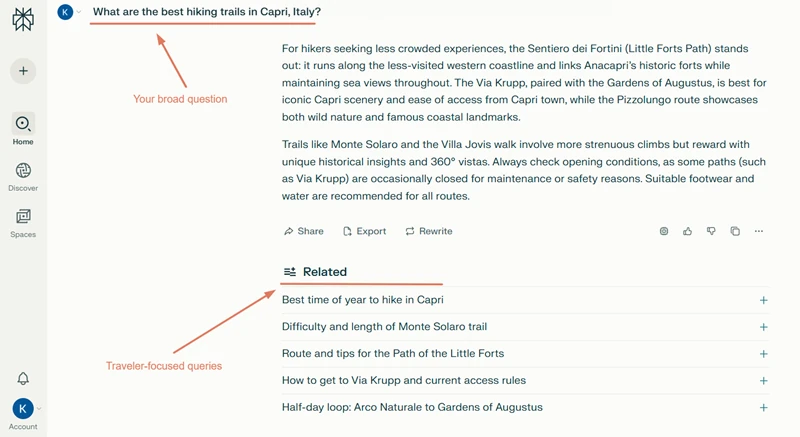
These queries reveal traveler intent — practical details (difficulty and length), experience-seeking curiosity (routes and tips), and up-to-date logistics (access rules). They also give you ready-made ideas for long-tail keywords, subheadings, or FAQs within your post.
Sometimes, as in this Hiking in Capri example, Perplexity’s Related section uncovers very specific, low-competition queries that few travel blogs have addressed. Spotting questions like these helps you fill content gaps and capture traffic from queries where competition is minimal but interest is strong.
For a full walkthrough on using Perplexity for topical research and keyword discovery — including how to analyze the Related section effectively — check out this in-depth guide.
3. Simulate traveler searches with ChatGPT
ChatGPT, an AI conversation model developed by OpenAI, can simulate traveler search behavior and reveal natural phrasing patterns. Simulating traveler searches simply means asking ChatGPT to act as if it were a traveler typing questions or phrases into Google. It helps you uncover how real people might word their searches, revealing natural phrasing and intent you can build your keyword list around.
This step is recommended but not mandatory. If Perplexity has already provided plenty of relevant keyword and topic insights, you can use ChatGPT mainly to expand on those ideas or fill gaps you notice in your list.
Ask ChatGPT to simulate traveler searches
Start with a simple prompt such as: “List 20 keyword variations for a travel blog post about hiking in Capri.”
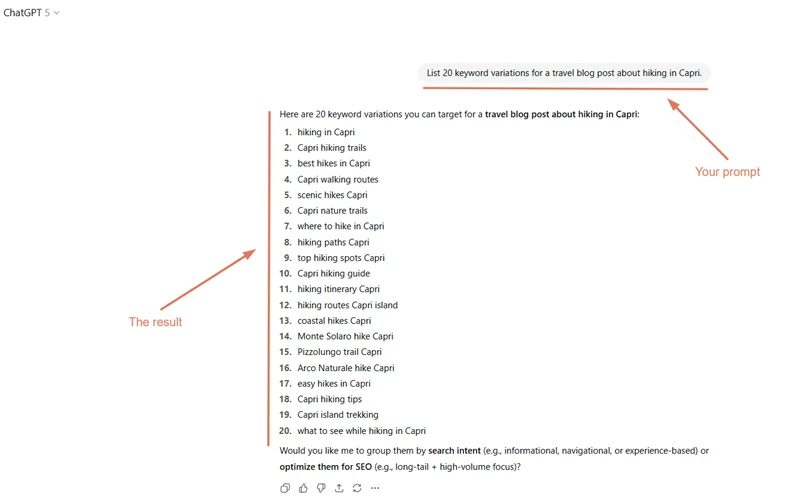
Then, go beyond generic lists. Ask ChatGPT to simulate how travelers would search depending on their needs or trip stage:
- “How would someone planning a trip to Capri search for hiking routes?”
- “What questions might travelers ask before hiking in Capri?”
Spot patterns in the keyword results
From these answers, clear patterns start to emerge. The words “Capri” and “hiking” appear in nearly every variation — your core seed terms. Around them, ChatGPT will surface several supporting clusters:
- Location-based terms like Anacapri, Monte Solaro, Pizzolungo, and Arco Naturale, which strengthen local SEO and help organize your sections.
- Intent-based modifiers such as best, easy, scenic, routes, paths, map, and tips, which reveal what travelers want to know or compare.
- Behavioral phrases like how to get, where to start, how long, what to wear, or is it worth it, which reflect the practical questions readers ask and make perfect FAQ material.
- Descriptive terms — sea views, coastal, hidden, off-the-beaten-path — that add emotion and storytelling depth.
Together, these clues show you the semantic ecosystem around your topic. Travelers commonly search in patterns such as:
| Pattern | Example |
|---|---|
| [activity] in [location] | hiking in Capri |
| best [activity type] in [location] | best hiking trails in Capri |
| [location] + [type of trail] | Capri walking routes |
| how to [verb] + [trail/landmark] | how to hike Monte Solaro |
| what to [do/wear/see] + while hiking in [location] | what to see while hiking in Capri |
| is [activity] in [location] + [adjective] | is hiking in Capri difficult / worth it |
| [landmark] + hike | Pizzolungo hike, Arco Naturale hike |
These patterns reveal traveler intent and highlight content gaps, like missing practical details that many travel blogs skip.
Prompt tip: Keyword pattern analysis
Copy and paste this prompt into ChatGPT to analyze recurring patterns across your simulated traveler search results:
“Analyze the keyword patterns across the [ three ] previous responses related to the same topic. Identify and explain the most common keywords, recurring phrases, and semantic themes. Group them by relevance (e.g., core keywords, supporting terms, intent-based modifiers, and descriptive or emotional terms). Then summarize the main keyword patterns and provide examples of how they typically appear in search queries. Finally, list the core recurring keyword stems that define the topic’s semantic core.”
Use this prompt after generating multiple query lists to quickly extract the underlying search language and structure for your topic.
Identify your topic’s semantic core
Looking across all the keyword patterns, you can identify the semantic core — the main group of words and ideas that consistently appear across all relevant searches.
Primary stems:
- Capri
- hike / hiking / hike(s)
- trail / route / path / walk
Secondary stems:
- best / easy / scenic / beautiful
- guide / tips / map / itinerary
- view / sea / nature
- Monte Solaro / Anacapri / Pizzolungo / Arco Naturale
- what / how / where / when / is
These core words form the backbone of your topic. They tell you which concepts matter most to travelers and which supporting terms naturally belong in your headings, FAQs, and image alt texts.
Refine and filter your keyword list
Once you’ve generated your list, filter it carefully. Remove phrases that shift away from your post’s intent — for example, “Capri hiking tour prices” leans commercial, while “Capri hiking map” stays informational. Focus on queries that align with your content goal and reflect what your ideal readers genuinely want to learn.
To get even more diverse results, try changing the traveler persona in your prompt:
- “Act as a family planning a day trip to Capri.”
- “Act as a solo traveler looking for scenic trails.”
Different traveler perspectives will reveal slightly different keyword sets — excellent inspiration for subheadings, FAQs, or even future posts.
By interpreting ChatGPT’s output this way, you’ll move beyond collecting keyword lists to understanding search language — turning AI-generated ideas into an SEO-ready, traveler-focused keyword framework.
4. Evaluate keyword data with SEMrush (or another SEO tool)
Once you’ve gathered ideas from Perplexity and ChatGPT, it’s time to bring data into the mix. Tools like SEMrush, a keyword research and SEO analytics platform, helps you check how each keyword performs in search, but the key is learning to read those numbers in context.
For a topic like hiking in Capri, enter your keyword list into SEMrush and review four core metrics:
- Search volume – how often people search for that term.
- Keyword difficulty (KD) – how competitive it is to rank.
- Search trend – how interest changes over time (great for spotting seasonal topics).
- Search intent – usually labeled as informational, navigational, or commercial.
According to SEMrush data, a keyword such as ‘Capri hiking trails’ might show medium volume and low difficulty, making it a realistic target for a travel blog. On the other hand, “hiking in Capri, Italy” might have higher volume but a commercial intent — better suited for a tour company than for a blogger.
Note 1: What counts as low, medium, or high search volume depends heavily on your topic. For niche destinations like hiking in Capri, a keyword with 150 searches per month can already be considered high volume. For broader topics, such as hiking in the Dolomites, “high volume” might mean 1,000+ monthly searches. Always assess volume in the context of your niche, not by a universal standard.
Note 2: When using SEMrush, make sure you’ve selected the correct region (e.g., US, UK, Italy). Search intent and keyword volume can vary across markets — and what travelers search in the US may differ from those in Europe. If you’re checking keywords in bulk, SEMrush defaults to one region, so open individual keyword reports to see global search volume and compare intent by country before finalizing your list.
Note 3: If you enter your domain name while checking a keyword’s metrics, SEMrush will show a personal keyword difficulty score and estimate your potential ranking position on SERP based on your site’s authority and current performance. This can help you prioritize keywords where your travel blog has realistic ranking chances.
In this step, interpret the data through a traveler’s lens — use the numbers to verify which search behaviors truly have measurable demand:
- High volume + low difficulty often signals broad interest — good for main topics.
- Lower volume + specific phrasing (like “Pizzolungo trail Capri”) usually points to niche intent — ideal for subheadings or supporting sections.
- Search trend data can highlight seasonal demand, such as increased searches for “hiking in Capri” from April to September — valuable for planning publication timing.
AI tools like Perplexity or ChatGPT can also help spot emerging travel destinations and seasonal interest shifts before traditional SEO tools catch up. For example, if AI-generated queries suddenly highlight “autumn trails in Capri,” that’s a sign travelers are starting to search beyond the usual locations — a valuable early trend signal for your next post.
You’ve already seen how phrasing reveals intent in traveler searches in step 3; here, data confirms those insights. For example, “best hikes in Capri” may have slightly higher volume but stronger comparison intent than “hiking in Capri,” helping you decide which should lead your post and which should support it.
This kind of interpretation helps you prioritize keywords that not only perform well in metrics but also align with where travelers are in their journey — from dreaming to planning to doing.
Tip: Don’t dismiss low-volume keywords too quickly.
For travel blogs, specific queries like “Pizzolungo trail difficulty” or “how to reach Arco Naturale” often bring readers who spend longer on your page and engage more. They may not drive massive traffic, but they build credibility and topical authority — which can help your site rank for broader terms later on.
5. Validate keywords through AI Overview results
The next step is to see how Google’s AI Overviews interpret your chosen keywords. This validation helps you understand whether Google sees a query as informational, commercial, or mixed, and what kind of content tends to appear for it.
It’s worth doing because search behavior is changing fast — zero-click results like AI Overviews now dominate many SERPs. Ranking within these summaries can significantly increase your visibility, even if users don’t click through in the traditional way.
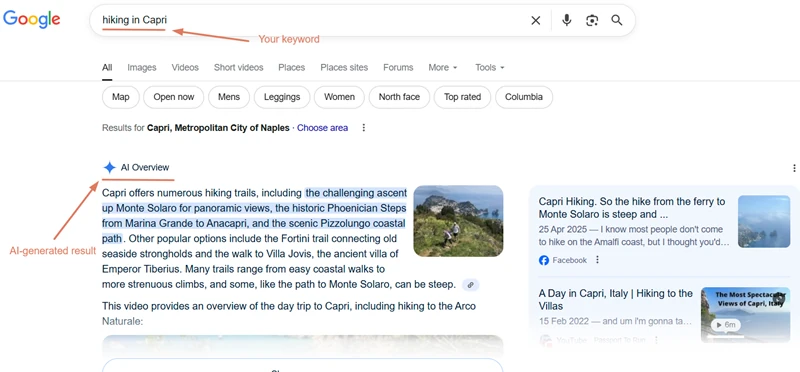
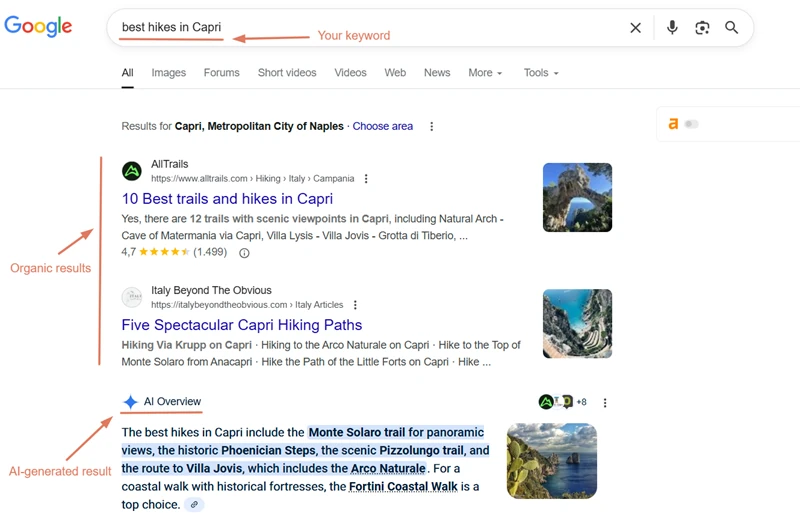
For this example, I checked how Google displays results for “hiking in Capri,” “Capri hiking trails,” and “best hikes in Capri” while keeping my Italian location detected. Here’s what I observed:
- “Hiking in Capri” → In my tests, the AI Overview appeared at the very top, before any organic results. This tells us Google strongly associates this query with informational intent and prefers to summarize key details directly.
- “Best hikes in Capri” → The AI Overview appeared after the first organic results. This suggests a mixed intent — users want curated recommendations (hence blog-style listicles ranking first) but Google still highlights summarized answers.
- “Capri hiking trails” → No AI Overview appeared, only organic results. This means the query is still dominated by traditional SEO competition, offering a clearer ranking opportunity for well-optimized blog content.
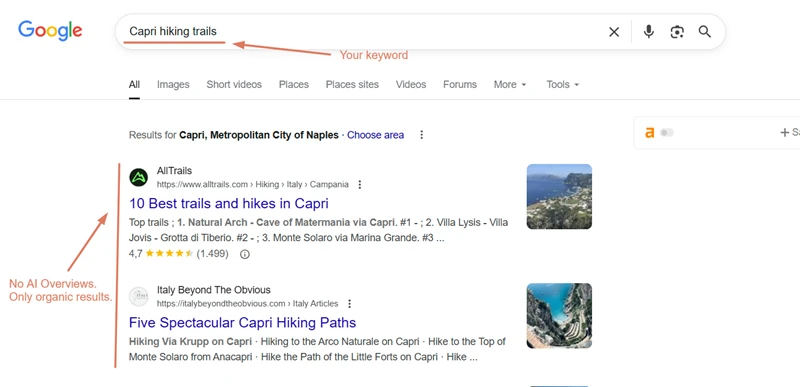
These differences are incredibly useful for shaping your content strategy. Queries that already trigger an AI Overview — like “hiking in Capri” — can be worth targeting, especially if you craft your copy to answer the same questions the AI summary pulls in. Meanwhile, queries without an Overview — like “Capri hiking trails” — give you a chance to occupy that informational space before AI summaries catch up.
If an AI Overview appears, take note of a few things:
- Content type: Are the cited sources blogs, travel magazines, or tourism websites?
- Tone and format: Does the overview summarize listicles, detailed guides, or quick facts?
- Citations: Which pages or domains are featured?
This gives you a sense of what Google’s AI considers trustworthy and relevant for that query. If AI Overviews highlight content similar to what you plan to write — for example, list-style travel guides like “Top 5 hikes in Capri” — that’s a good signal. It means your content idea aligns with how Google currently interprets the topic.
If the Overview doesn’t appear, or if it favors commercial content (e.g., tour booking sites), that’s equally useful. It tells you this keyword might not be the best fit for an informational post — or that it’s an opportunity to cover a less optimized angle with better long-term potential.
Note: AI Overview results can vary by region and user profile. Use an incognito window or a VPN when checking to avoid results personalized by your browsing history or location.
When you analyze AI Overviews this way, you’re not just validating a keyword — you’re confirming its content potential. It’s a way of aligning your travel post with how Google’s evolving search ecosystem interprets user intent.
Tip: Pay attention to the wording of the Overview summaries. Phrases like “According to travel blogs…” or “Guides recommend…” show that Google recognizes blog content as authoritative for that query — a strong indicator that your post can compete in both search and AI-generated answers.
6. Cluster related keywords
After reviewing your keyword metrics and AI Overview results, the next step is to organize your keywords into clusters that reflect both traveler intent and the visibility patterns you discovered. Keyword clustering means grouping semantically related terms so each group supports a distinct section of your post — and so you can see which queries deserve the most depth.
For a travel topic like hiking in Capri, your clusters might look like this:
| Cluster | Example keywords | Intent / Use in post |
|---|---|---|
| General hiking in Capri | hiking in Capri, Capri hiking trails, hiking Capri Italy | Core topic – title and introduction |
| List or comparison content | best hikes in Capri, top trails in Capri, scenic hikes Capri | Curated section highlighting routes and viewpoints |
| Specific trail details | Pizzolungo trail Capri, Arco Naturale hike, Monte Solaro trail | Subsections focused on individual routes with tips and photos |
| Trip planning & logistics | Capri hiking map, best time to hike Capri, Capri trail difficulty | Practical info and FAQs |
Clustering this way mirrors how readers explore information: they start with a broad question (Is hiking in Capri worth it?), then move toward specific trails and practical planning. This approach prevents cannibalization and helps Google understand how each section supports your main topic.
As you organize clusters, use search intent to shape your outline — comparison phrases like “best hikes in Capri” work well for list sections, while practical terms such as “map” or “route” fit naturally into FAQs or planning parts.
Note: You can cluster keywords manually in a spreadsheet or use tools like SEMrush Keyword Manager or Keyword Insights to speed up the process.
Tip: When organizing your clusters, think of them as mini content themes. If a group of keywords feels too broad for one section, it might deserve its own dedicated blog post later (for example, “Best coastal hikes in Capri” could become a follow-up to your general hiking guide).
7. Select one primary keyword and supporting ones
Now that your keywords are grouped into clusters, it’s time to decide which keyword will lead your post and which ones will support it. This step is about prioritizing, using what you’ve learned from search metrics, AI Overview visibility, and traveler intent to pick the most strategic focus for your content.
Choosing a clear primary keyword gives your article direction, while supporting keywords strengthen topical depth and help your post rank for related queries across your clusters.
Start broad and refine:
- From 30+ ideas, shortlist 10 that best fit your topic and intent.
- From those 10, narrow to 5 based on search volume, difficulty, and ranking potential in your region.
- From those 5, choose 1 primary keyword — the one that best aligns with your post’s purpose and what Google already surfaces in AI Overviews.
For example, if your topic is hiking in Capri, your shortlist might include:
- hiking in Capri
- best hikes in Capri
- Capri hiking trails
Among these, “hiking in Capri” works best as the primary keyword — it’s broad enough to capture the main informational intent and already appears prominently in Google’s AI Overview. The others make excellent supporting keywords, guiding your subtopics, section headings, and FAQs.
Tip: Think of your keyword hierarchy as a pyramid. Your primary keyword defines the overall theme, while the supporting ones build context and signal topical completeness to search engines.
Note: If you’re unsure which keyword to prioritize, check SERP intent alignment. Search each option in Google and see what types of posts rank. The one whose results best match your planned format (listicle, guide, itinerary, etc.) is usually your best bet.
8. Add LSI keywords for depth
The final step is to enrich your post with LSI (Latent Semantic Indexing) keywords. In plain terms, LSI keywords are just naturally related words or phrases that help search engines understand your topic better. Think of this step as fine-tuning: LSI keywords strengthen the connections between your clusters, helping Google fully understand the scope of your content.
For a post about hiking in Capri, and based on our insights so far, LSI keywords might include:
- trail difficulty
- scenic viewpoints
- coastal paths
- walking routes
- Monte Solaro
- sea cliffs
- best season to hike
Including these terms signals to search engines that your article covers the topic in depth while also making it richer and more natural for readers.
You can find LSI keywords by:
- Checking Google’s “People also ask” and “Related searches” sections.
- Exploring SEMrush’s Keyword Magic Tool for semantically connected phrases.
- Using AI tools like ChatGPT or Perplexity to ask, “What related terms or topics should a post about hiking in Capri mention?”
When adding them to your post:
- Use them naturally in sentences or subheadings — avoid forced repetition.
- Spread them throughout key areas like your intro, trail descriptions, and FAQs.
- Add them to subtle on-page elements such as internal link anchors or image alt texts — for example, Capri hiking map showing scenic coastal trails (see this guide on how to write image alt text for details.)
- Avoid overuse; 5–10 LSI terms are usually enough for a 1,500-word post.
Note: LSI keywords can also help you spot content gaps. If related searches repeatedly mention “trail safety” or “hiking gear,” consider adding a short section or quick tips paragraph to make your guide more complete.
Tip: Treat LSI keywords as the finishing touches of your SEO process. They’re the small but meaningful details that make your post feel written by someone who’s truly experienced the place and that authenticity is exactly what Google values most.
Wrapping up your keyword research process
Keyword research isn’t just about finding words that rank — it’s about understanding how travelers search and how your content can meet them there. This 8-step process blends traditional SEO with AI-informed discovery to help you align with both search data and user behavior. Tools like Perplexity and ChatGPT reveal how travelers phrase their questions and what topics matter to them most, while platforms like SEMrush keep your choices grounded in measurable opportunity.
By defining intent, validating your keywords across both SERPs and AI Overviews, clustering them strategically, and layering in LSI terms, you’re not just optimizing for search engines — you’re writing content that speaks the language of real travelers.
And that’s what modern travel SEO is all about: staying visible, staying useful, and staying ahead as search becomes more conversational, contextual, and AI-powered.
Quick FAQs:
Every few months or before publishing new posts — especially if travel seasons or AI Overviews shift.
Not entirely. They complement it by showing how real travelers phrase their questions, while SEO tools provide performance data.
They serve different purposes — Perplexity surfaces live trends, while ChatGPT helps simulate how travelers think and search.
Final tip: Take inspiration from what already ranks
Before you start writing, peek at a few top-ranking blogs for your target keyword. Notice what subtopics they cover, how they structure their post, and what angles you might add or improve.
It’s a quick way to spot content gaps and make sure your travel guide feels more complete than what’s already out there.