FAQs can be surprisingly useful in travel content, but only when they answer the right questions in the right place.
A destination guide, itinerary, hotel review, or travel article can all benefit from FAQs in different ways. Sometimes they help readers make faster decisions. Sometimes they support long-tail search queries. And sometimes they clarify information that AI tools may otherwise summarize poorly.
In this guide, we’ll look at how to use FAQs for SEO, AEO, GEO, and AI search without turning your blog posts into bloated question lists.
You’ll learn:
- when to add an FAQ section, standalone FAQ page, Q&A article, or full guide
- how to choose questions that deserve space
- where FAQs should appear inside travel content
- how to write answers that help readers and search systems
- when FAQ Schema or HowTo Schema makes sense
- how to keep travel FAQs accurate over time.
Table of Contents
FAQs are not dead. FAQ rich results are.
For years, many bloggers treated FAQ sections as a quick SEO win.
Add questions. Add answers. And add FAQ Schema. Get those expandable dropdowns in Google. Enjoy more space in the search results.
That playbook no longer works in the same way.
Google has now confirmed that FAQ rich results no longer appear in Google Search. It is also removing the FAQ search appearance, FAQ rich result report, and Rich Results Test support for FAQ structured data.
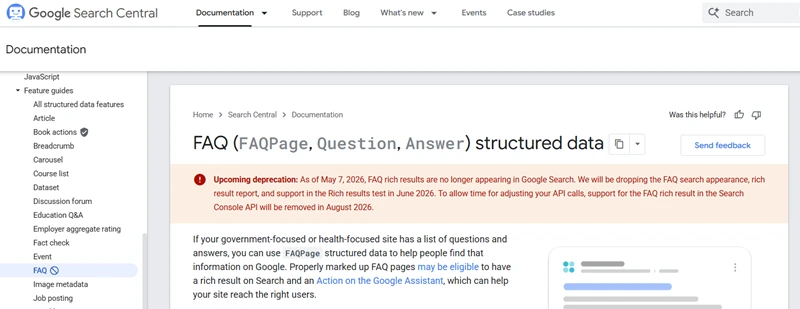
So, if your main reason for adding FAQs is “I want FAQ rich results,” that reason is gone.
This is where the distinction matters: FAQ content and FAQ Schema are two different things. FAQ Schema is the structured data you add in the code. It describes question-and-answer content to search engines. FAQ content is the visible text on the page. It is what readers actually see.
So the takeaway from this update is simple: don’t build FAQ sections around a Google rich result that no longer exists.
What FAQs should actually do in travel content
FAQs should help readers deal with the small doubts that come up while planning a trip. These doubts are not always big enough for a full section, but they can still affect someone’s decision.
For example, a guide about “3 days in Seville” may already cover the main itinerary. But the reader may still wonder:
- Is Seville walkable?
- Is July too hot for sightseeing?
- Should I book the Alcázar in advance?
- Can I visit Córdoba as a day trip?
- Is Seville expensive compared to Madrid or Barcelona?
These are micro-intents. They sit around the main topic and help the reader decide what to do next.
A useful FAQ section can help you cover those micro-intents without changing the main structure of the article.
For travel content, FAQs work best when they:
- clarify practical details
- answer a related question quickly
- add useful internal links
- highlight first-hand travel experience
- make changing information easier to update.
If someone is reading your article about visiting Lake Bled without a car, they may not only care about buses from Ljubljana. They may also want to know whether they can reach the main viewpoints, whether taxis are available, or whether staying near the lake makes the trip easier.
Those details make the article more useful because they answer the questions readers often ask after the main topic is already covered.
However, FAQs shouldn’t repeat the article. If you already explained the best time to visit in a full section, you do not need to answer the exact same question again at the end.
Instead, use FAQs to answer what the main copy does not cover naturally.
A simple rule helps: if the answer makes the page more useful, keep it. If it only makes the page longer, cut it.
FAQ section, standalone FAQ page, Q&A article, or full guide?
Not every question belongs in an FAQ section.
Some questions need a short answer. Some need a full guide. Others work better as a Q&A article, especially when the source or personal perspective matters.
| Content need | Best format | Travel example |
|---|---|---|
| The topic needs depth, photos, routes, opinions, and context | Full blog post | 3 days in Rome |
| The question supports a larger topic but does not need a full section | FAQ section | Is Rome safe at night? |
| The question deserves a direct search-focused answer | Short answer article | Is Venice worth visiting in winter? |
| The value comes from personal input, expert insight, or a conversation | Q&A article | A local answers common questions about Trieste |
| The questions explain your blog, services, reviews, or editorial standards | Standalone FAQ page | How this travel blog chooses hotel recommendations |
| The reader needs a sequence of actions | How-to guide | How to buy train tickets in Italy |
A full travel guide works best when the reader needs context. For example, “where to stay in Rome” is not a simple FAQ answer. It needs neighborhood comparisons, budget notes, safety context, transport tips, and examples of who each area suits.
An FAQ section works better when the question supports the main topic but doesn’t need a long explanation. In a Rome guide, “Can you visit Rome without a car?” can be answered clearly in a short block because most travelers don’t need a separate post for that.
A standalone FAQ page works best when the questions apply across your site, not just one destination. For example, a travel blog may use a standalone FAQ page to explain:
- who writes the guides
- whether the trips are based on first-hand experience
- how often the content is updated
- how hotel, restaurant, or tour recommendations are chosen
- whether the site uses affiliate links
- how readers or brands can get in touch.
This can also support GEO because it gives AI tools clearer information about your blog as an entity.
A Q&A article works best when the format itself adds value. This could be an interview with a local, a conversation with a tour guide, or a post based on reader questions after a trip. For example, “A local answers common questions about Trieste” feels more natural as a Q&A article than as a standard destination guide. The value comes from the person answering, not only from the information itself.
You can also use short answer articles when one question has enough search intent to stand alone. For example:
- Is Venice worth visiting in winter?
- Is Lake Como expensive?
- Can you visit Plitvice Lakes without a car?
- Is Copenhagen good for a weekend trip?
These posts can still include a few FAQs at the end, but the main article should answer the central question in more depth.
A strong travel site can use all these formats. The real skill is knowing which one fits the reader’s needs.
Where to place FAQs inside travel content
FAQs don’t always belong at the end of the article.
A question should appear where the reader is most likely to ask it. Sometimes that is near the end. Other times, it belongs much earlier.
Near the top
Place a question near the top when it affects whether someone keeps reading.
For example, if you write a guide about visiting Plitvice Lakes, the reader may want to know right away if they can swim there, whether tickets sell out, or whether they can visit without a car. If these answers are buried at the bottom, the reader may leave before they find them.
This also works for itinerary content. If your article is about “one day in Trieste,” an early answer to “Is one day enough for Trieste?” can help the reader understand whether the guide fits their plans.
Inside the relevant section
Some FAQs belong inside the part of the article where the question naturally comes up.
For example:
- In a transport section: “Do you need a car?”
- In a ticket section: “Should you book in advance?”
- In a neighborhood section: “Where should first-time visitors stay?”
- In a food section: “Do restaurants close between lunch and dinner?”
- In a budget section: “Is this destination expensive?”
This keeps the answer close to the context. It also makes the page easier to scan because readers don’t need to jump to the bottom for every small detail.
Near comparison sections
FAQs are useful when readers need help choosing between two options.
For example:
- Should you stay in Naples or Sorrento?
- Is Lake Como or Lake Garda better without a car?
- Should you visit Verona or Padua as a day trip from Venice?
- Is it better to visit Seville or Granada first?
These questions work well near comparison tables, itinerary options, or “best for” sections. They help readers make a decision while they are already thinking about the choice.
At the end of the article
The end of the article still works well for supporting questions. Use the final FAQ section for quick answers that are helpful but not central to the article.
For example:
- Is tap water safe to drink?
- Can you visit with luggage?
- Is the destination stroller-friendly?
- What should you wear?
- Are credit cards widely accepted?
- Is it worth visiting in the off-season?
These questions can add value without interrupting the main flow.
Answer high-friction questions early. Add section-specific questions where they belong. Use the final FAQ section for extra details readers may want before they leave.
Think of FAQs as answers placed where they are most useful.
How to choose FAQ questions worth answering
Not every question deserves space on the page.
A good FAQ should support the main topic, help the reader make a decision, or add information that the main copy does not cover naturally.
Start with real questions
Start with real questions, not guesses. You can find them in:
- Google Search Console queries
- People Also Ask results
- Google autocomplete
- related searches
- Reddit and travel forums
- blog comments
- emails from readers
- social media comments
- questions you had while planning the trip
- questions your travel partner asked
- AI tools like ChatGPT, Perplexity, or Gemini.
You can also use Perplexity AI to research related questions, compare search results, and find angles you may have missed. It is especially useful when you want to see how different sources explain the same travel topic and where the gaps are. For a more detailed workflow, read this guide on how to use Perplexity AI to research travel topics for better SEO and AI visibility.
I created this guide by researching the topic in Perplexity: asking questions, reading the answers, and checking the Related section beneath each response. It helped me understand what travel bloggers are actually asking about FAQs and where the existing answers felt incomplete.
AI tools can help you brainstorm, but they should not be your only source. Travel FAQs need real-world context, search data, and common sense.
Check if the question deserves space
Before adding a question, ask:
- Would a real reader ask this while planning?
- Does the answer help them make a decision?
- Does it belong on this page?
- Can I answer it better than a generic search result?
- Will I keep it updated if the answer changes?
A question is worth answering when it affects the trip in a practical way.
For example:
- Can you visit without a car?
- Do you need to book tickets in advance?
- Is one day enough?
- Is the area safe at night?
- Is it still worth visiting in winter?
- What should you skip with limited time?
These questions help readers plan, compare, or avoid mistakes.
Avoid repeating what the article already says
Skip questions that repeat what you already explained clearly. Also skip questions that only exist because a keyword tool showed search volume. For example, if your article already has a detailed section about the best time to visit Stockholm, you don’t need an FAQ that repeats the same advice word for word.
You can still include a related question if it adds a different angle – for example:
- Main section: Best time to visit Stockholm
- Useful FAQ: Is Stockholm too cold in December?
- Weak FAQ: When is the best time to visit Stockholm?
The first FAQ adds a specific concern. The second one repeats the section.
Keep the FAQ section short
There is no perfect number of FAQs.
In most cases, 2 to 5 well-chosen questions are enough for a travel blog post, destination guide, itinerary, or review. That gives you space to answer useful follow-up questions without turning the page into a long list of repeated or low-value answers.
A standalone FAQ page is different. Since the whole purpose of the page is to answer grouped questions, it can include more. But even there, the questions should be organized by theme, not added randomly.
A simple rule works better than a fixed number: add only the questions that make the page more useful. Stop before the FAQ section starts to feel like padding.
How to write FAQ answers for SEO, AEO, GEO, and AI search
A good FAQ answer should work even when someone reads it outside the full article.
This matters because answers can appear in search snippets, People Also Ask-style results, AI summaries, internal site search, or answer engines.
For travel content, the answer needs enough context to stand on its own.
Make every answer useful on its own
Weak answer: “Yes, but it depends on what you want to do.”
Stronger answer: “Yes, you can visit Lake Bled without a car if you stay near the lake or arrive by bus from Ljubljana. However, a car helps if you want to visit nearby viewpoints, gorges, or smaller villages on the same day.”
The stronger answer works better because it names the destination, gives a direct answer, adds the condition, and helps the reader decide.
Use this simple structure: direct answer → context → travel-specific detail → next step.
For example: “Yes, Trieste is walkable if you stay near the city center. However, some areas are hilly, and Miramare Castle is outside the center, so you will need a bus, taxi, or bike if you want to include it in a short visit.”
This kind of answer helps both readers and search systems because it is clear, specific, and easy to understand.
Keep answers specific, clear, and current
Here’s how the same FAQ answer can support different types of search visibility:
| Visibility type | What the FAQ answer should do |
|---|---|
| SEO | Match the question and support the page’s main topic. |
| AEO | Answer the question quickly and clearly. |
| GEO | Include useful entities, such as destination names, attractions, transport options, seasons, and country names when needed. |
| AI search | Avoid vague wording and include enough context to make sense outside the full article. |
In practice, that means you should:
- start with the answer
- name the destination clearly
- explain what the answer depends on
- include practical travel details
- add first-hand experience when useful
- link to deeper content when the reader needs more help
- mention dates, seasons, or current rules when they matter.
Avoid:
- “it depends” without explanation
- generic answers that could fit any destination
- repeating the same copy from the article
- adding keywords where they do not sound natural
- giving fixed answers to information that changes often.
For example, this answer is too vague: “Yes, Rome is safe, but you should be careful.”
A stronger version would be: “Yes, Rome is generally safe for tourists, especially in central areas during the day. However, pickpocketing can happen around busy places like Termini Station, the Colosseum, and crowded buses, so keep your bag closed and avoid carrying valuables in easy-to-reach pockets.”
The second answer is more useful because it gives the reader specific context. It also avoids making safety sound absolute.
Good FAQ answers are usually short, but they should not be empty.
Aim for enough detail to answer the question properly. For many travel FAQs, that means 40 to 90 words. Some simple answers can be shorter. More complex answers may need a full section instead of an FAQ.
FAQ Schema vs HowTo Schema for travel blogs
Schema should describe the content that already exists on the page. It shouldn’t decide what you write.
Use FAQ Schema only for visible Q&A content
FAQ Schema fits visible question-and-answer content.
For example:
- Is Florence worth visiting in December?
- Can you visit Venice without a car?
- Is Dubrovnik expensive?
- How many days do you need in Seville?
- Should you book the Colosseum in advance?
These questions may need context, but they don’t need a step-by-step process.
You can still use FAQ Schema if the questions and answers are visible on the page. However, don’t add FAQs only because your SEO plugin offers a schema block.
Know the main FAQ Schema properties (plus example)
FAQ Schema is usually added as JSON-LD inside the page’s HTML. The main properties are simple:
| Property | What it means |
|---|---|
| @context | Tells search engines the vocabulary comes from Schema.org |
| @type | Defines the page or item type, such as FAQPage, Question, or Answer |
| mainEntity | Holds the list of questions on the page |
| name | The text of each question |
| acceptedAnswer | The answer connected to each question |
| text | The visible answer text |
Here is a simple FAQ Schema example for a travel article:
<script type="application/ld+json">
{
  "@context": "https://schema.org",
  "@type": "FAQPage",
  "mainEntity": [
    {
      "@type": "Question",
      "name": "Can you visit Lake Bled without a car?",
      "acceptedAnswer": {
        "@type": "Answer",
        "text": "Yes, you can visit Lake Bled without a car if you stay near the lake or arrive by bus from Ljubljana. However, a car helps if you want to visit nearby viewpoints, gorges, or smaller villages on the same day."
      }
    },
    {
      "@type": "Question",
      "name": "Is one day enough for Lake Bled?",
      "acceptedAnswer": {
        "@type": "Answer",
        "text": "One day is enough to walk around the lake, visit Bled Island, see Bled Castle, and enjoy the main viewpoints. If you also want to visit Vintgar Gorge or nearby villages, staying overnight gives you more flexibility."
      }
    }
  ]
}
</script>
The marked-up questions and answers should match the content readers can see on the page. Do not add extra questions only in the code.
Use HowTo content for step-by-step tasks
HowTo content works when the reader needs to complete a process.
For example:
- How to buy train tickets in Italy
- How to book Colosseum tickets online
- How to get from Naples to Pompeii by train
- How to plan a day trip from Bologna to Modena
These topics need ordered steps, not only short answers.
Google deprecated How-to rich results in Search in 2023, so the main value of how-to structure is clarity, not rich-result visibility.
Match the format to the intent
Here is a simple way to decide:
| Content type | Better format |
|---|---|
| “Is Rome safe at night?” | FAQ |
| “How to buy Vatican Museum tickets” | How-to guide |
| “Can you visit Lake Como without a car?” | FAQ |
| “How to travel from Milan to Lake Como by train” | How-to guide |
| “3 days in Madrid” | Full article with optional FAQs |
The practical rule is simple: write the useful content first. Add schema only when it accurately describes that content.
How FAQs support your blog’s entity and brand clarity
FAQs are not only for destination guides. They can also help explain your blog, your process, and your editorial standards. This is useful on pages where readers want to understand who you are and how your content works.
Good places for brand-level FAQs include:
- About page
- editorial policy page
- work with me page
- services page
- standalone FAQ page
- travel resource hub.
Answer questions about your blog, not one destination
A travel blog can use FAQs to answer questions like:
- Who writes this blog?
- Are the guides based on first-hand travel?
- What destinations does the blog cover?
- How often are guides updated?
- How are hotels, tours, restaurants, or tools selected?
- Does the site use affiliate links?
- Does the blog accept sponsored content?
- How can readers or brands get in touch?
These questions usually do not belong inside a destination guide. They work better on brand-level pages because they explain the site as a whole.
Use FAQs to make your positioning clearer
For RankTrails, a standalone FAQ section could explain:
- who RankTrails helps
- what travel SEO topics it covers
- whether the advice is for travel bloggers, tourism brands, or both
- how RankTrails approaches SEO, GEO, AEO, and AI search
- whether examples come from real travel content
- how often SEO guides are reviewed or updated.
This is useful for readers and for AI systems because it gives them a clearer picture of the site.
The goal is not to write promotional answers. The goal is to make important information easy to find and summarize correctly.
How to keep travel FAQs accurate and current
Travel FAQs can become outdated quickly, especially when they mention prices, schedules, routes, tickets, or rules.
A simple way to manage updates is to group FAQs by risk. The more a wrong answer can affect someone’s trip, the more often you should review it.
| FAQ type | Examples | Review frequency | Why it matters |
|---|---|---|---|
| High-risk FAQs | Ticket prices, opening hours, ferry routes, train schedules, visa rules, attraction closures, local restrictions, safety warnings, seasonal access, event dates, booking rules, public transport passes | Every few months, or sooner when something changes | These answers can affect someone’s budget, timing, booking decisions, or ability to visit |
| Medium-risk FAQs | Best areas to stay, average travel costs, public transport advice, whether a place is expensive, restaurant and café recommendations, crowd patterns, best months to visit, day trip advice | Once or twice a year | These answers may not change every month, but they can become less accurate over time |
| Low-risk FAQs | Is the city walkable, is one day enough, what to skip with limited time, what type of traveler would enjoy this place, what you would do differently next time | Once a year, or when you update the main article | These answers are often based on experience or general trip logic, so they usually stay useful longer |
For answers that depend on current rules, prices, or schedules, add a short “last checked” note – for example:
- Last checked: June 2026. Ferry schedules change by season, so confirm the timetable before booking accommodation.
You don’t need this note for every FAQ. Use it when freshness affects the reader’s decision.
A wrong answer about whether a city feels walkable is annoying. A wrong answer about visa rules, ferry schedules, or ticket requirements can seriously affect someone’s trip.
Conclusion
FAQs are still useful in travel content, but their role has changed. They are no longer a quick way to win extra SERP space with FAQ rich results. Instead, they help you answer the small but important questions travelers ask before they trust a guide, follow an itinerary, book tickets, or choose a destination.
For SEO, AEO, GEO, and AI search, the best FAQ sections are clear, specific, and easy to understand outside the full article. They support the main content instead of repeating it. They also give readers practical answers about timing, transport, safety, prices, routes, seasons, and travel decisions.
Before adding FAQs to your next travel post, remember:
- Add FAQs only when they make the page more useful.
- Keep most FAQ sections short, with 2 to 5 strong questions.
- Place questions where readers are most likely to need them.
- Write answers that are specific to the destination or travel situation.
- Treat schema as a technical layer, not the reason for adding FAQs.
- Review time-sensitive FAQs before they become outdated.
A good FAQ section should not make your travel content longer for the sake of it. It should make the page clearer, more helpful, and easier to trust.