Ever wondered why your “Top 10 things to do” post ranks below a local tour site that barely writes any blog content? The answer lies in search intent — the reason behind every traveler’s Google search.
In plain terms, search intent is what a person really wants to find when they type a query. It could be inspiration (“best islands in Greece”), planning (“Seville 3-day itinerary”), or booking (“book food tours in Rome”). These small differences reveal what stage of the traveler journey they’re in — dreaming, planning, or ready to act.
For travel bloggers, understanding this is key. When your post matches a traveler’s intent, it naturally performs better — it ranks higher, keeps readers engaged longer, and leads to more clicks, bookings, and shares.
In this guide, we’ll look at how search intent works in travel SEO, the main types of traveler queries, and how to recognize them directly in Google results. You’ll see how to map real examples to intent types, identify hybrid and micro-intents, and interpret SERP features that show what travelers want.
By the end, you’ll know how to create travel content that feels genuinely useful to readers — and visible to search engines.
Table of Contents
What is search intent (in the context of travel queries)?
Search intent is the reason someone types a travel-related question into Google. It reveals what travelers really want to do at that moment — whether they’re dreaming of destinations, planning details, or ready to book.
When your post matches that intent, Google understands your content is relevant and shows it to the right people. That’s how you go from just another travel blog to a resource that solves real traveler needs.
The main types of search intent (with travel examples)
| Intent type | Example travel queries | What the searcher wants | What you should create |
|---|---|---|---|
| Informational | “best time to visit Japan”, “how to get from JFK to Manhattan” | To learn or research | Travel guides, how-tos, itineraries, packing lists, FAQs |
| Navigational | “Lonely Planet Italy guide”, “Trenitalia timetable” | To reach a specific website or page | Clear site navigation, branded content, about pages |
| Commercial investigation | “best safari tours in Kenya”, “Santorini vs Mykonos” | To compare options before booking | Comparison posts, pros/cons tables, detailed reviews |
| Transactional | “book Rome food tour”, “cheap hotels in Lisbon tonight” | To complete an action (book, buy, sign up) | Booking or affiliate pages, strong CTAs, deals sections |
The reality: most travel searches are hybrid
A lot of travel queries mix intents. Take “Rome food tours” — it’s part informational (“what’s available?”) and part transactional (“how do I book?”).
If you only write a list of tours, you miss the readers who are ready to book. If you only focus on affiliate links, you lose those still researching. So, the best approach is to blend: offer quick info at the top, honest comparisons in the middle, and booking options or CTAs near the end.
Why understanding search intent matters for travel bloggers
- It keeps the right readers on your page. People find what they came for instead of bouncing back to Google.
- It helps your content rank higher. Posts aligned with user intent fit Google’s goal: giving searchers the most relevant answer.
- It shapes your content strategy. You’ll know which posts should inform, inspire, or convert, so every article serves a clear purpose.
Search intent in travel blogging means understanding why travelers search. When your post matches that intent — whether they’re researching or ready to book — it attracts the right audience and ranks higher.
The traveler journey and how intent evolves
Every traveler starts somewhere — maybe with a daydream, a TikTok video, or a conversation with a friend. But before they book anything, they go through several search moments.
These moments reveal what travelers want right now, and that’s what we call search intent evolution. As travelers move from inspiration to action, their queries change — and your content should change with them.
The four stages of the traveler journey (and what they search for)
| Stage | Example queries | Intent type | What content works best |
|---|---|---|---|
| 1. Inspiration | “most beautiful towns in Italy”, “hidden beaches in Greece”, “best places to visit in spring” | Informational | Bucket-list posts, photo roundups, storytelling, destination inspiration |
| 2. Research & planning | “things to do in Bologna”, “how to travel between islands in Thailand”, “budget for 10 days in Japan” | Informational → Commercial investigation | Itineraries, how-tos, travel cost breakdowns, detailed destination guides |
| 3. Decision & booking | “best boutique hotels in Lisbon”, “book Rome food tour”, “cheap flights to Amsterdam” | Transactional / Commercial | Affiliate content, booking guides, deals, service reviews, CTA-optimized posts |
| 4. Pre-trip & post-trip | “what to pack for Iceland in winter”, “where to store luggage in Tokyo”, “best souvenirs from Croatia” | Informational / Navigational | Packing lists, logistics tips, post-trip reflection or sharing prompts |
How intent shifts with each step
Think of it like a funnel:
- At the top, travelers want inspiration. They’re not ready to book; they just want ideas.
- In the middle, they’re comparing. They’re narrowing down destinations or activities.
- At the bottom, they’re ready to act. That’s when “book,” “price,” or “best deals” start showing up in searches.
As a travel blogger, you can build content around each stage so readers stay within your blog throughout their journey.
Pro tip:
Interlink your posts to guide readers from inspiration → planning → booking.
Example: A “10 Best Towns in Italy” post links to “2-Week Italy Itinerary,” which then links to “Book Hotels in Tuscany.”
This creates a natural flow that mirrors user intent and keeps your readers (and Google) happy.
Understanding this evolution strengthens your SEO and reader engagement by helping you:
- Build topical authority, showing Google that your blog covers the full traveler journey.
- Keep readers on your site longer by anticipating their next question and guiding them naturally.
- Create organic monetization opportunities through content that leads readers from curiosity to action without feeling salesy.
Travelers’ search intent evolves from dreaming to booking. Aligning your content with each stage — by inspiring, guiding, and helping them act — keeps your blog visible through the entire journey.
How to identify search intent behind travel queries
Recognizing what travelers really mean when they type something into Google is easier than it seems. Once you know what to look for, you can quickly tell whether a search is about inspiration, comparison, or booking and tailor your post accordingly.
Here’s a simple step-by-step way to identify search intent for travel queries:
Step 1. Start with keyword research
Begin by collecting a list of travel-related keywords using tools like Google Keyword Planner, SEMrush, or Ahrefs.
Pay attention to the modifiers, the small words that reveal intent:
- “how to,” “guide,” or “ideas” → informational
- “best,” “vs,” or “review” → commercial investigation
- “book,” “price,” or “cheap” → transactional
These modifiers are your first clue about what travelers want to achieve.
Tip: take your keyword research further
Once you’ve identified traveler intent with these modifiers, the next step is turning those insights into a focused keyword list.
In my guide on travel blog keyword research, I show how to combine traditional SEO tools like SEMrush and Google Keyword Planner with AI assistants such as Perplexity and ChatGPT to uncover what travelers are really searching for, and how to use that data to plan your next post.
Step 2. Look at the SERP (search results page)
Type the queries into Google and study what shows up. The results themselves reveal what travelers expect to find.
- Blog posts, guides, or itineraries → informational intent
- Comparison posts or reviews → commercial investigation
- Booking sites, hotel listings, or tour providers → transactional intent
Take note of extra SERP features — maps, carousels, “Things to do” boxes, and People Also Ask sections. These tell you what type of content Google thinks best answers that query.
You can also use tools like Perplexity AI to explore what questions travelers ask most often — it helps you uncover hidden sub-topics beyond Google results.
Step 3. Identify the dominant intent and plan your content
After reviewing the SERP, decide which intent is strongest and how your post will match it. Most queries clearly point in one direction, but, as mentioned earlier, some combine multiple intents.
For example:
- “best hikes in Madeira” → mainly informational, but may attract people planning a trip soon.
- “Rome food tours” → hybrid: informational (what’s available) + transactional (book a tour).
Once you’ve identified the dominant intent:
- For informational queries, write detailed, helpful guides.
- For commercial queries, focus on comparisons or curated options.
- For transactional queries, make booking easy and trustworthy.
When a query blends intents, structure your post to address both — an informative overview first, followed by practical booking details or CTAs.
Finally, group your keywords by intent before writing. This helps every post serve a clear role — whether it’s to inform, inspire, or convert.
Pro tip: use Perplexity, ChatGPT, or similar AI tools to see related questions travelers ask around your keyword. These questions often reveal intent directly and make great subheadings or FAQs.
Real examples: mapping travel queries to intent
Understanding theory is one thing, but seeing how it plays out with real travel searches makes it click instantly. Let’s look at a few common queries and see how their intent shapes the kind of content you’d want to create.
| Travel query | Dominant intent | What the SERP shows | Best content approach |
|---|---|---|---|
| best time to visit Bali | Informational | Blog posts, AI Overviews, featured snippets, “People also ask” boxes | Write a seasonal guide that covers weather, festivals, and crowd levels. Add visuals like monthly temperature charts to boost snippet potential. |
| Rome food tours | Hybrid (Informational + Transactional) | Maps, tour listings, booking links, “Related products & services” section, “People also ask” boxes | Combine an intro that explains different types of food tours with a curated list of recommendations and affiliate booking links. |
| Santorini vs Mykonos | Commercial investigation | Comparison posts, travel blogs, YouTube videos, “People also ask” boxes, AI Overviews | Write a detailed comparison highlighting differences in vibe, price, and experiences. Include “best for” sections (e.g., best for nightlife, best for couples). |
| book hotels in Lisbon | Transactional | Hotel booking sites, ads, maps | Use this keyword for affiliate-focused content. Make CTAs and booking links prominent, but keep it authentic — include your own photos or tips to add trust. |
| hidden beaches in Greece | Informational | Blog posts, image packs, listicles, AI Overviews | Publish an inspirational post with personal insights, map embeds, and strong visuals. End with links to nearby accommodation or itinerary posts. |
What these examples show
- Intent determines structure. Each query needs a different mix of storytelling, facts, and CTAs.
- SERP features guide your formatting. If Google shows maps or “things to do,” include similar elements in your content to align with user expectations.
- Blending intent works best in travel. Many travel searches combine curiosity and action, so structuring your post to handle both keeps readers (and algorithms) satisfied.
Pro tip:
Build small intent clusters around one destination to keep travelers on your site longer. For example, you could connect these three posts about Sevilla, Italy:
- “Best time to visit Sevilla” → informational
- “3-Day Sevilla itinerary” → commercial investigation
- “Book guided tours in Sevilla” → transactional
Together, they guide readers from research to booking in one seamless flow—and you can bring it to life with a personal photo from your trip to make the post feel more genuine and local.

Advanced: hybrid and micro-intent in travel searches
We’ve already seen that some travel queries don’t fit neatly into one box. A single search can mean more than one thing, and that’s where hybrid and micro-intent come in.
Hybrid intent shows when travelers have two or more goals in one search.
Micro-intent reveals the personal motivation behind that goal — the subtle “why” that shapes how people choose.
Together, they explain the real complexity behind travel searches and why one blog post can satisfy multiple audience needs at once.
Understanding hybrid intent
Hybrid intent is the bridge between curiosity and action. It appears when travelers are researching but already leaning toward a decision.
How it forms:
- A traveler has gathered enough information to start comparing options but hasn’t booked yet.
- Their search includes both informational and commercial or transactional elements.
Examples:
- “best safari tours in Kenya” → learn and compare and possibly book.
- “where to stay in Amalfi Coast” → find inspiration and check prices.
- “guided hikes in Cinque Terre” → understand options and see what’s available to reserve.
How to recognize it in the SERP:
- Mix of blog posts and booking sites.
- “Things to do” boxes or map packs alongside reviews and comparison lists.
- Ads or affiliate results appear near guides and blog content.
How to optimize for it:
- Inform first. Begin with helpful context — best areas, what to expect, or key differences.
- Compare and recommend. Offer clear choices, pros and cons, and personal insights.
- Make action easy. End with affiliate links, CTAs, or “book now” prompts that feel like a natural next step.
Example from real travel blogs:
Nomadic Matt’s “Bali travel guide” post is a great example of hybrid intent. It starts by explaining areas (informational), compares pros and cons (commercial), and ends with booking links (transactional). Studying posts like this helps you see how to blend all three seamlessly.
Hybrid intent is where travel bloggers can really shine: you’re not just inspiring readers; you’re guiding them toward a confident decision.
Pro insight:
Booking sites usually jump straight to the sale, while travel blogs succeed by guiding the decision process first. Your advantage as a blogger is tone and trust — readers expect storytelling, not sales talk. Use that to bridge the gap between curiosity and action.
Understanding micro-intent
Micro-intent dives deeper. It’s about the traveler’s motivation — the emotion or priority behind their query. Two people might type “weekend in Florence” but mean very different things: one wants romance, the other wants art and culture.
Common micro-intents in travel:
- Budget-focused: “cheap hostels in Lisbon,” “free things to do in Paris.”
- Luxury-seeking: “5-star spa resorts in Tuscany.”
- Eco-conscious: “eco-friendly hotels in Madeira,” “sustainable tours in Peru.”
- Family-oriented: “best resorts for kids in Crete.”
- Experience-driven: “local cooking classes in Bangkok,” “wine tours near Florence.”
- Seasonal or event-based: “Christmas markets in Vienna,” “summer festivals in Croatia.”
How to recognize micro-intent:
- Look for descriptive modifiers (budget, romantic, family, sustainable, luxury, local).
- Pay attention to SERP visuals: family photos, eco badges, or price ranges hint at micro-intent.
- Explore People Also Ask questions as they often expose the “why” behind the query (e.g., “Is Santorini better for couples or families?”).
How to use it strategically:
- Adjust your tone and imagery to fit the emotion: romantic posts feel soft and personal; adventure posts feel energetic and action-oriented.
- Create content clusters that branch from one destination keyword into micro-intents (e.g., “family hotels in Dubrovnik,” “romantic stays in Dubrovnik,” “budget hostels in Dubrovnik”).
- Use micro-intent tags in headings or subheadings — Google reads them as context cues (“Best budget eats in Prague,” “Eco-friendly day trips from Porto”).
Micro-intent is subtle but powerful — it’s what turns a generic guide into a post that feels written just for someone.
Bringing hybrid and micro-intent together
Real travel searches often combine both layers.
Someone searching “affordable honeymoon resorts in Bali” shows:
- Hybrid intent (researching vs. booking)
- Micro-intent (budget + romance)
By addressing both, your post feels complete: it informs, compares, inspires, and gently leads to conversion, all in one piece of content.
Hybrid intent mixes curiosity with decision-making, while micro-intent reveals the motivation behind it. Recognizing both helps you create travel content that speaks to real human needs and naturally guides readers from inspiration to booking.
SERP features that signal traveler intent
Google doesn’t just show results. It gives away clues about what people really want. By learning to read these signals, you can spot traveler intent at a glance and shape your content to match what’s already working in the search results.
When you search for travel-related topics, pay attention to what appears above and around the blue links. Each SERP feature tells you something about the intent behind that query.
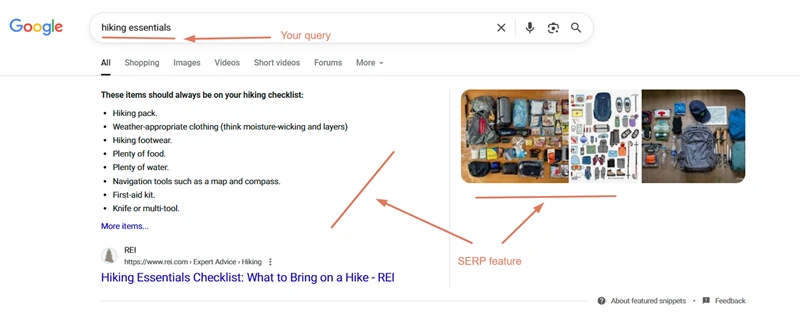
Featured snippets (Quick answers)
When Google displays a compact list, paragraph, or table above regular search results, that’s its way of giving you a quick, high-confidence answer — often signaling informational intent.
For example, search “hiking essentials”, and you might see a checklist-style snippet (items like backpack, navigation tools, first-aid) displayed right at the top — before any full articles.
How to use it:
- Start your post with a concise answer (1–2 sentences) before expanding.
- Use structured lists or tables for clarity.
- Add seasonal data or quick facts to increase your chance of being featured.
Summary pannels
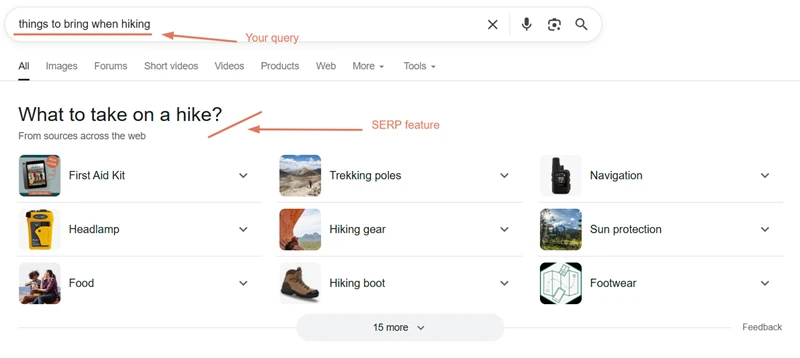
Google is increasingly using aggregated summary panels (labeled “From sources across the web”, “Found on the web”, or similar) that draw from multiple content sources.
These summary panels can act much like a featured snippet — giving users quick answers and pushing down other organic results — but they’re technically a distinct SERP feature. And because featured snippets are now harder to trigger in many niches, it’s smarter to optimize for the summary panel format.
For example, search “things to bring when hiking”, and Google may display a checklist (First Aid Kit, Headlamp, Navigation, Sun Protection, Footwear, etc.) right above the organic links—that panel gives users exactly what they need at a glance.
How to use it:
- Begin your article with a clear, concise summary or list that resembles what the panel might show.
- Format crucial items using bullets or short, labeled entries (e.g. First Aid Kit, Navigation Tools).
- Use descriptive headings or bold terms for each entry, so algorithms see them as distinct points.
- Expand your content with related subtopics (e.g. weather, cost, tips) to provide depth.
- Keep your facts and stats up to date.
So, as you can see, the optimization approach for summary panels is very much like that used for featured snippets — using lists, concise summaries, and structured content.
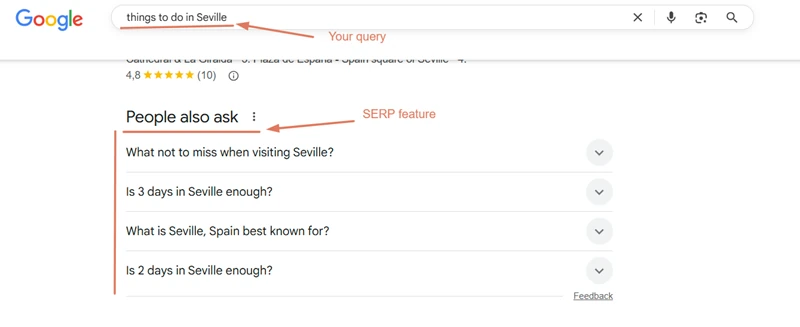
“People also ask” (PAA) box
This is Google showing follow-up questions travelers commonly ask. It almost always signals informational or hybrid intent.
For example, a query like “things to do in Seville” might trigger questions such as:
- “Is Seville worth visiting in winter?”
- “Is 3 days in Seville enough?”
- “What not to miss when visiting Seville?”
How to use it:
- Use these questions as subheadings or an FAQ section in your post.
- Provide short, clear answers (40–60 words) under each question.
- Update older posts to include new PAA topics you find on SERP.
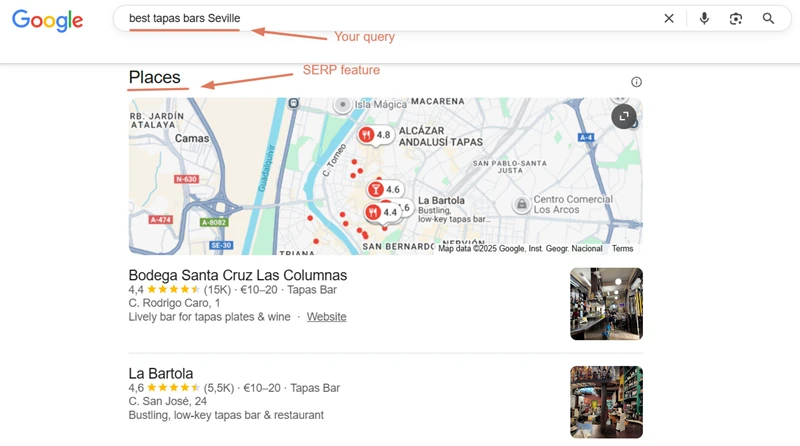
Map packs and local results
If Google shows a map with pins, reviews, or directions, the intent is local and action-oriented — people are planning or booking.
For example, search “best tapas bars Seville,” and you’ll see maps, star ratings, and hours of operation.
How to use it:
- Add Google Maps embeds or links to relevant places.
- Include local tips, addresses, and walking routes.
- Use schema markup for Place, LocalBusiness, or Tour when relevant.
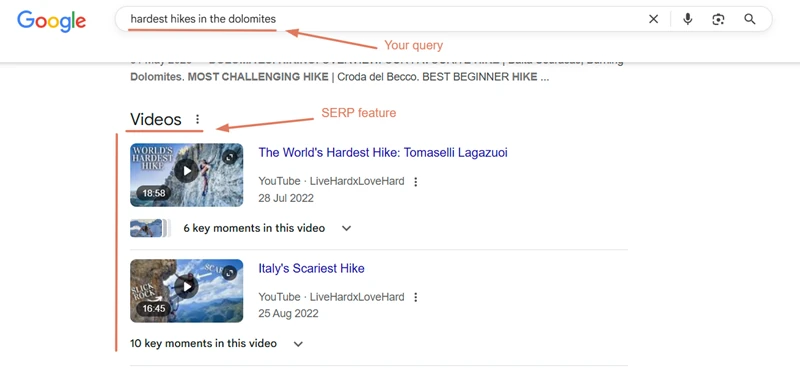
Image and video carousels
These appear when travelers are looking for visual inspiration or experiences. They suggest informational or commercial intent depending on the query.
Example: “Hardest hikes in the dolomites” often triggers a photo carousel or YouTube preview.
How to use it:
- Include high-quality vertical images with descriptive file names.
- Add alt text like “hardest hikes in the dolomites, Italy” to strengthen relevance. (Check out this guide to writing image alt text for travel photos to make your content more discoverable in Google Images.)
- Create short videos or Reels and embed them directly into your post to keep users on your page longer.
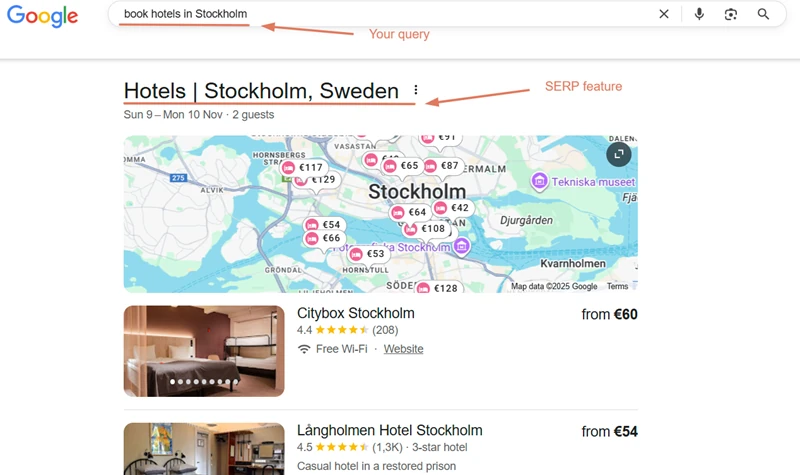
Booking and product modules
Hotel packs, flight widgets, and “Things to do” carousels are clear signs of transactional intent.
For instance, search “book hotels in Stockholm” or “Berlin tours,” and you’ll see booking widgets or tour provider cards before organic results.
How to use it:
- Optimize affiliate or booking content for clarity and trust—include honest reviews, personal photos, and transparent pricing.
- Use affiliate disclosures clearly but naturally within your copy.
- Keep CTAs simple: “Check availability,” “Compare prices,” or “Book your stay.”
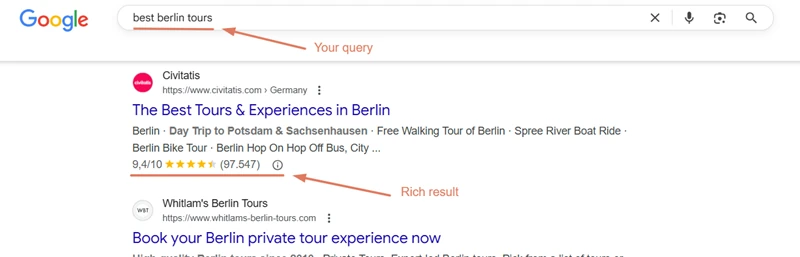
Reviews and ratings
When star ratings, snippets, or testimonials appear, they indicate commercial investigation intent — people are comparing options.
How to use it:
- Include personal reviews or summaries from traveler feedback.
- Use schema markup for Review or AggregateRating to increase your visibility in rich results.
- Be specific — “4.8-star food tour with local guides” reads better than “great tour.”
AI Overview (Generative answers)
AI Overviews are becoming a more prominent element in search results — and in many cases, they appear in place of traditional featured snippets.
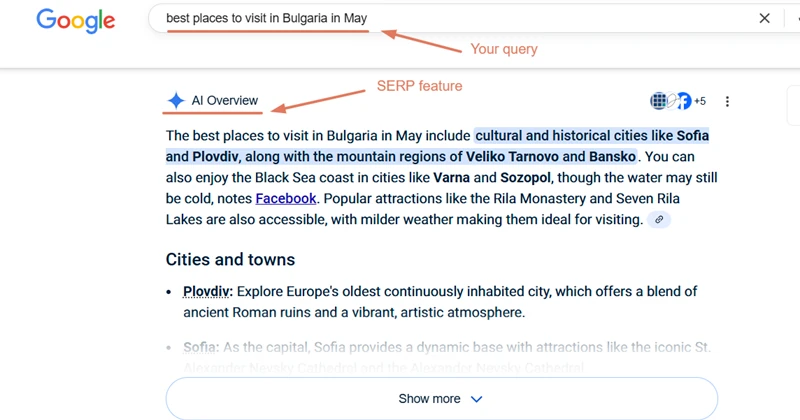
These generative summaries blend quick definitions, recommendations, and links into one coherent answer block. They now show up for a broader range of query types — not just simple informational ones — including travel queries that are planning-focused, comparison-driven, or hybrid in nature.
What it tells you about intent:
Travelers want crisp, meaningful responses without extra clicks. When AI Overviews appear, Google is signaling that users expect a distilled, reliable summary. Those queries aren’t always purely informational — many are mid-journey queries where people are weighing options or deciding.
How to adapt your content:
- Lead with a concise definition or clear summary of the topic.
- Use Q&A-style subsections or question-based headings that reflect how travelers phrase queries.
- Organize your content using bullet lists, numbered steps, and brief summaries — formats that AI systems more easily parse.
- Cover several subtopics (e.g. weather, cost, events, peak season) under one umbrella query to show topical depth.
- Keep all data, figures, and claims accurate and up to date, since AI Overviews tend to favor trustworthy, current content.
Discussions & Forums (when they appear)
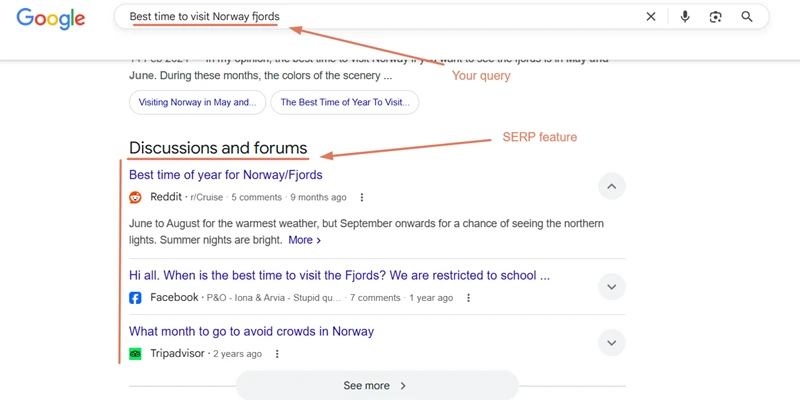
Sometimes Google surfaces forum threads or community discussions under queries, especially when travelers are seeking real opinions, experiences, or tradeoffs. This “Discussions & Forums” block doesn’t always show up, but when it does, it signals that Google thinks readers want more than facts — they want voices.
Example:
For “best time to visit Norway fjords,” you’ll find active forums such as this TripAdvisor thread: “Please could anyone tell me when would be the better time to take a cruise to the fjords? I have the opportunity to go either end of June or mid-August.”
That shows that at least some travelers are comparing real conditions (rain, daylight, crowds) and relying on others’ advice, not just reading guides.
How to use it wisely:
- Add personal experience, traveler tips, or quotes in your content — use narrative or local insight, so your post reads like something worth citing.
- Use subheadings or FAQ questions that echo discussion-style queries (e.g. “Is June better than August for fjord cruises?”).
- Include conversational or long-tail phrasing that matches how people talk (e.g. “end of June or mid August for a fjord cruise?”) to align with natural queries.
- Monitor your target SERPs: if you see a forum block appear, adapt your content by adding more firsthand voices or Q&A answers.
- Add discussion forum and profile page markup.
Because the “Discussions & Forums” block is not predictable, treat it as a helpful signal — if present — rather than a rule. It suggests the value of human perspective in your posts, but shouldn’t override the core intent alignment you already built in.
Reading the SERP like a travel SEO
Think of the SERP as your real-time intent detector. Each feature reflects what travelers want at that moment: quick answers, visuals, comparisons, or bookings.
By mirroring those same patterns in your content — snippets, FAQs, local info, visuals, and now AI-ready structure — you position your blog to appear in both classic and generative search results.
Conclusion
Understanding how travelers search is the foundation of every strong travel SEO strategy. Once you learn to recognize what people really want—whether it’s inspiration, comparison, or booking — you stop guessing and start creating content that meets them exactly where they are in their journey.
Remember: search intent isn’t static. It shifts with seasons, trends, and new travel habits. Keep an eye on how queries evolve, and you’ll start noticing small but powerful shifts, like when “hidden beaches in Italy” becomes “quiet beaches near Bari.” Those moments are your cue to refresh and re-engage.
And as Google’s AI Overviews continue to reshape how travelers discover information, structure your posts with clarity, concise takeaways, and trustworthy details. That’s how you stay visible, both in traditional SERPs and in the next wave of AI-driven results.
By understanding search intent — and learning how to act on it — you’re not just optimizing for Google. You’re creating helpful, reliable, people-first travel content.