If you’ve ever spent time writing the perfect one-line summary for your travel post, here’s a curveball: Google is testing AI-generated search snippets that can completely rewrite your meta descriptions. That means the little piece of text you carefully craft — the one that’s supposed to convince people to click your Santorini itinerary or your Paris food guide — might soon be written by Google’s AI instead.
So, does that make meta descriptions obsolete? Not quite.
Even as search evolves, your meta descriptions still play a huge role in shaping how your content is displayed, understood, and clicked. Whether it’s your words or Google’s, what you write still influences what users (and AI) see.
This guide breaks down how to write meta descriptions that actually get clicks — with simple tips and examples tailored to travel bloggers.
Table of Contents
The future of meta descriptions: will AI make them obsolete?
In the world of travel blogging, you’re familiar with crafting that irresistible snippet under your page title – the meta description that promises adventure, emotions, and the unique story your post delivers. But what if that little bit of copy isn’t quite under your control anymore?
Recently, Google began testing AI-generated meta descriptions — summaries automatically written by its systems to appear in search results. The experiment currently includes two formats:
- one where Google’s AI fully replaces the meta description, and
- another where the system adds a short AI summary below your existing snippet, marked with a Gemini icon.
Why this matters for you as a travel blogger: your meta description has traditionally been one of the few places you could control what people see in search results. Even though Google has never guaranteed use of your meta description, you could still influence how your page appeared in the SERPs. (Google’s clarification on how snippets are chosen)
With this change, your control might shrink — and that means two big implications:
Implication A: Your snippet might not reflect your travel-blogging voice anymore.
You might spend time writing a snappy line like: “Explore the hidden canals of Venice on a sunset gondola ride — travel tips, local eats & photo-hotspots.”
And yet Google’s AI could pick up on other parts of the copy and present something else entirely. That risks losing your brand tone, your storytelling flair, or the emotional hook that makes a travel blog link stand out.
Implication B: Click-through rate (CTR) and visibility may shift.
Early evidence suggests that when AI-generated snippets appear, click-through rates for traditional listings drop.
For a travel blog, where getting readers to click in is essential (especially for monetization, affiliate links, building an audience), this begs the question: How do you stay ahead?
What this means for your meta descriptions.
Even if your meta description may be overridden, it’s still worthwhile — but the focus shifts from “craft the perfect snippet” to “make your content snippet-ready”. Think of your meta description as part of a broader system:
- Create clear, well-structured content so any AI summary can pull the right message.
- Lead with your key benefit (e.g., “Plan your week-long Greece island-hop with these insider tips”).
- Keep your meta description aligned with the first few lines of your article (so that if Google pulls from page content, your framing is still strong).
- Monitor your CTR and behavior in search, especially if you see a drop when AI snippets appear.
In short, the era of “just write a great meta description and move on” is evolving. For travel bloggers, this means doubling down on structural clarity, storytelling hooks, and on-page alignment. So, whatever shows up in the SERP, whether it’s your original copy or Google’s AI summary, still drives clicks and reflects your unique travel voice.

What a meta description really does (and why it still matters for travel blogs)
Even with AI now rewriting snippets, meta descriptions still matter. They may not directly influence Google’s rankings, but they play a role in how users interact with your travel content — and that interaction affects your visibility in more ways than one.
At its core, a meta description is a short HTML tag that summarizes what your page is about. It’s the text that appears below your title in search results, helping people decide whether to click your link or someone else’s. Think of it as the elevator pitch for your blog post — a 150-character chance to convince readers that your story is worth their time.
Here’s why it’s still worth writing:
It drives clicks — and clicks drive visibility
Meta descriptions don’t directly boost rankings, but click-through rate (CTR) does send strong engagement signals to search engines. A well-written snippet that makes readers curious (“Discover secret cafés in Lisbon locals love”) can outperform a higher-ranked but generic listing.
In other words, your meta description can turn an ordinary impression into a site visit — the kind that helps your blog grow organically.
It defines your voice in the SERP
Your travel blog has personality — maybe it’s laid-back, inspiring, or full of local secrets. The meta description is your first chance to express that voice before users even land on your page.
If Google’s AI pulls a snippet from your post, having that tone visible early in your content helps retain brand consistency. It’s about shaping how your story feels in search results, not just how it ranks.
It sets reader expectations
A clear, honest meta description ensures users get exactly what they expect when they click. If your snippet says “Best places to eat in Florence on a budget,” and your article delivers just that, readers stay longer and explore more — two positive engagement signals that support SEO performance.
While Google hasn’t confirmed that these behaviors are direct ranking factors, they contribute to a better user experience — which Google’s algorithms consistently reward over time.
It can influence AI summaries and featured results
Even as Google continues to test AI-generated snippets and summaries in search results, the role of a written meta description isn’t obsolete. It still helps by providing a clear fallback and structured signal for both users and algorithms.
Put simply: the meta description can influence how your content is represented in AI-driven search experiences — though it’s important to remember this capability is still emerging and not yet guaranteed.
Example: how a meta description shapes visibility
Imagine two similar travel posts about hiking in the Italian Dolomites:
- Generic snippet: “A guide to hiking in the Dolomites.”
- Optimized snippet: “Discover the most scenic Dolomites hikes with local tips, maps, and must-see viewpoints.”
The second example immediately conveys value (local insights, maps, highlights) and emotional appeal (“most scenic”), which makes it far more clickable — and more likely to align with any AI-generated summary Google might test in the future.
In short, meta descriptions for travel blogs remain an essential bridge between your story and your readers. They don’t control rankings, but they do control first impressions, and that’s still one of the most powerful tools in travel SEO.
How to write irresistible meta descriptions for travel content
A good meta description should make readers feel like clicking is the start of their journey. So, how do you write one for a travel blog post that actually gets noticed?
1. Lead with action
Start your meta description with a strong verb — something that makes readers want to move:
- Discover hidden places
- Explore must-see sights
- Find travel hacks
- Plan your next trip
Travel is about doing, not reading. So, words like discover, explore, experience, or plan instantly create energy and urgency.
Example: “Discover the best cafés and sunset spots in Lisbon — a guide packed with local tips and hidden gems.”
Why it works: It uses active language (“discover”), evokes curiosity (“hidden gems”), and stays within the 150 character limit.
2. Match your reader’s intent
Before writing, ask: What would someone typing this query into Google actually want?
If the search is for “best time to visit Japan,” your meta description should answer that exact intent:
“Wondering when to visit Japan? Learn the best seasons, festivals, and local tips for an unforgettable trip.”
Matching intent doesn’t just attract the right readers — it helps Google’s AI understand your content context, making it easier for your post to appear in both organic and AI-generated results.
To dig deeper into how to align your snippets with what travelers are really searching for, check out my post on understanding and leveraging traveler’s search intent.
3. Add emotional hooks
Travel is emotional. Use sensory or feeling-based language to connect. A good travel meta description should make readers feel something — excitement, curiosity, nostalgia, or adventure.
Example: “Escape to the Amalfi Coast with our 5-day itinerary — stunning views, coastal hikes, and unforgettable food stops.”
It tells a story in one line and invites readers to imagine the experience — that’s what makes it clickable.
4. Include your target keywords naturally
Keywords like “Paris travel guide” or “best budget hotels in Rome” should appear naturally, not forced. They help your description stay relevant to both human readers and AI-driven search systems.
It’s ideal to include an exact match of your target keyword when possible, but that can be tricky with long-tail keywords (for example, “things to do in Paris on a budget”).
When a perfect match doesn’t fit naturally or exceeds the character limit, the next best approach is to include its most important parts while keeping the sentence smooth and meaningful.
“Plan your Paris adventure with our complete travel guide — top sights, cafés, and budget-friendly tips.”
Here, the keyword (“Paris travel guide”) fits seamlessly without sounding forced — the perfect balance between readability and SEO relevance.
5. Keep it between 120 and 150 characters
While Google may display up to 160 characters, Yoast SEO — one of the most widely used WordPress plugins — flags anything outside roughly 120–150 characters as too short or too long.
Keeping your description in this range ensures it’s visible across devices and passes plugin checks.
Put your most important words at the beginning — especially on mobile, where space is tighter.
6. Make each one unique
Every page deserves its own meta description. If you use the same text across multiple posts (“Explore my latest travel guides!”), Google may ignore it altogether.
Instead, highlight what makes that post unique:
- For an itinerary → focus on destination and duration.
- For a review → highlight what you tested or experienced.
- For a guide → mention what problem it solves (budget, time, hidden spots).
Example: “Read my honest review of the Venice Vaporetto pass — real costs, best routes, and whether it’s worth it.”
This tells readers exactly what to expect and builds trust.
7. Add a gentle call to action
You don’t have to sound salesy but give readers a reason to click. Try CTAs that feel natural for travel content:
- “Start planning your trip”
- “Get inspired for your next adventure”
- “Find out where locals really eat”
Example: “Explore Tokyo beyond the tourist spots — discover secret cafés, street food, and the neighborhoods locals love.”
It invites curiosity, uses action verbs, and ends with a subtle CTA.
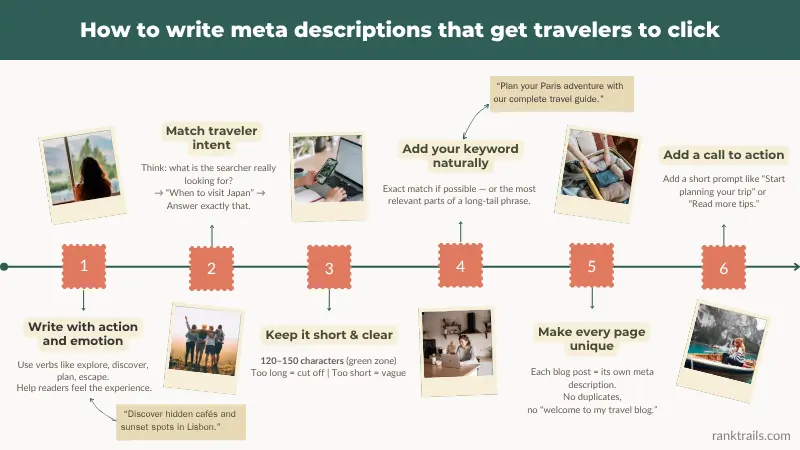
Download this infographic and save it as a quick reference for your next travel blog post — no forms, just one click.
Example table: meta descriptions by content type
| Travel content type | Example meta description | Why it works |
|---|---|---|
| Destination guide | “Explore the best of Santorini — beaches, sunsets, and local tips to plan your dream Greek getaway.” | Combines emotional appeal, descriptive detail, and CTA. |
| Itinerary | “Plan your perfect week in Bali — temples, waterfalls, beaches, and insider tips from real travelers.” | Uses structure and excitement while staying relevant to intent. |
| Review post | “Read our honest review of the best hotels in Rome — real photos, hidden costs, and what’s truly worth it.” | Builds credibility and sets expectations. |
| Travel tips article | “Learn simple packing hacks to travel lighter — essential tips for stress-free adventures.” | Solves a reader’s problem directly. |
| Food & culture piece | “Taste the real Naples — street food favorites, local pizzerias, and the dishes Italians swear by.” | Sensory words + location-based keyword = high engagement. |
Quick recap
When writing meta descriptions for travel blogs:
- Lead with action.
- Match intent.
- Keep it emotional but clear.
- Include your target keyword or its key parts naturally.
- Stay between 120–150 characters for best visibility and plugin accuracy.
- Make each description unique and end with a light CTA.
Because even in the age of AI-generated snippets, human curiosity still wins clicks.
What are the most common meta description mistakes travel bloggers make?

Even great travel content can lose clicks if your meta description misses the mark. Here are the mistakes most travel bloggers make — and the simple mindset shifts to fix them.
Common pitfalls to avoid:
- Don’t duplicate descriptions: Each blog post deserves its own meta description. Duplicate text makes search engines skip your snippet altogether.
- Don’t stuff keywords: One clear mention of your keyword is enough. Write for travelers, not bots.
- Don’t mislead readers: Keep your description honest and aligned with what’s actually on the page — it builds trust and reduces bounce.
- Don’t get too vague: “Welcome to my travel blog” tells no one what’s inside. Always include the destination, topic, or benefit.
- Don’t neglect user intent: Write with the reader’s goal in mind — whether they’re planning a trip, looking for inspiration, or comparing options.
- Keep it within 120–150 characters: That’s the sweet spot for Yoast and mobile previews. Longer ones get cut off; shorter ones lack context.
- Avoid overusing symbols or emojis: Too many ✈️💫🔥 distract and may not display correctly. Stick with simple punctuation and one clean dash (“—”) for separation.
- Don’t forget to review old posts: Outdated or missing meta descriptions are easy to overlook. Audit them quarterly using Google Search Console (GSC), Ahrefs, or Screaming Frog SEO Spider.
Meta descriptions for travel blogs don’t need to be perfect — just clear, specific, and authentic. Avoiding these simple mistakes ensures your snippets reflect your travel voice and keep your readers clicking.
How can you monitor and optimize your meta descriptions for better CTR?
Writing a meta description is only half the job — the other half is knowing if it’s actually working. The good news? You don’t need fancy tools or complex analytics setups to track performance. Here’s what you can do.
Use Google Search Console (GSC) to spot underperforming snippets
In GSC, open Performance → Search results, then:
- Filter by page or query to see how your blog posts are performing.
- Look at the CTR (click-through rate) column — this tells you how often people click your post after seeing it in search results.
If a page has high impressions but low CTR, your title or meta description may not be compelling enough.
That’s your cue to rewrite it with a clearer hook, emotional trigger, or stronger call to action.
Example:
If your post “Best things to do in Prague” gets thousands of impressions but a low CTR, your snippet might look too generic.
Try testing:
“Explore the best things to do in Prague — castles, cafés, and hidden spots locals love.”
Even small wording changes can lift CTR noticeably over time.
Test and compare performance over time
When you update a meta description, don’t just hit “save” and forget it — track how it performs.
In Google Search Console, look for pages with high impressions but low CTR. Rewrite those descriptions with stronger hooks or clearer benefits, then compare performance before and after the update.
Check again after two to four weeks. If CTR improves while rankings stay the same, your new meta description is doing its job.
You can also test two versions over time:
- Keep version A for a month, note CTR and impressions.
- Swap in version B next month and compare results.
For travel blogs, this works especially well when testing emotional vs. informational phrasing — for example:
- Informational: “Plan your Amalfi Coast itinerary with our 5-day guide.”
- Emotional: “Escape to the Amalfi Coast — 5 days of sun, sea, and slow travel.”
Small differences like tone or structure can make a noticeable impact on clicks.
Use SEO plugins for quick optimization insights
If you’re on WordPress, plugins like Yoast SEO or Rank Math help you:
- See live character counts (staying within the 120–150 range).
- Spot missing or duplicate meta descriptions.
- Preview how your snippet will appear on desktop and mobile.
These tools are great for catching basic issues before you publish.
Audit regularly — especially older content
Travel content changes fast, so audit meta descriptions with three quick passes:
- Outdated wording (content freshness)
- Look for time-sensitive phrases (e.g., “updated for 2023,” event dates, prices) and seasonal details that may be stale.
- Refresh with current info or evergreen phrasing.
- Missing meta descriptions (coverage check)
- In Screaming Frog, Ahrefs, or SEMrush, filter for pages with no description. SEMrush audit reports are especially useful for spotting missing or duplicate descriptions, though note that on the free plan you can audit only up to 100 pages per month.
- Add concise, unique snippets (120–150 chars, Yoast-friendly).
- Duplicate meta descriptions (uniqueness check)
- Filter for duplicate descriptions across posts (common on similar guides).
- Rewrite each to reflect the specific angle (itinerary length, neighborhood, review vs. guide).
Prioritize: high-impression, low-CTR pages in Google Search Console → then missing → then duplicates → then “nice-to-fix” outdated phrasing.
Track the impact of AI-generated snippets
As Google continues experimenting with AI-generated search descriptions, watch how your snippets appear in real results.
Search your blog post titles manually (in incognito mode) and note whether Google displays your written meta description or an AI-generated summary.
If AI versions start showing more often, make sure your first 2–3 lines of body text are as strong and descriptive as your meta description.
Quick recap
To keep your meta descriptions performing:
- Watch CTR trends in Google Search Console.
- Update weak or outdated snippets regularly.
- Stay within 120–150 characters for optimal display.
- Test emotional vs. factual phrasing for travel topics.
- Keep your opening lines snippet-ready in case Google’s AI rewrites them.
A good meta description doesn’t just describe your post — it’s your blog’s handshake in search results. And like any good handshake, it should feel genuine, confident, and memorable.
Key takeaways and summary
Google’s AI experiments (Google Search Central Blog) might change how snippets appear, but they don’t change one truth: your words still matter.
Meta descriptions are no longer just about ticking an SEO box — they’re about creating small but powerful invitations for readers to explore your stories.
Here’s what to remember when writing meta descriptions for travel blogs:
- Be clear and emotional. Use action verbs that invite readers to explore.
- Match traveler intent. Write for what users actually search.
- Keep it short. Stay between 120–150 characters.
- Use keywords naturally. Exact match if it fits, partial if it reads better.
- Stay honest. Promise only what the post delivers.
- Monitor results. Track CTR in Search Console and update low performers.
- Adapt to AI. Well-structured content ensures any AI snippet still reflects your voice.
In the end, a good meta description does more than summarize your blog — it tells a story in one line.
Make that line count, and your travel posts will keep standing out, no matter how search evolves.
FAQs
Framing your meta description as a question can spark curiosity and encourage clicks. Use it when your content directly answers that question, like “Looking for hidden cafés in Lisbon?” Keep it short and specific so users (and AI systems) instantly see that your post holds the answer.
Your title tag, URL, and meta description should tell the same story. They work best when they share the same focus keyword and intent. For instance, if your title is “Best beaches in Crete,” your URL could be /crete-beaches-guide and your meta description “Discover Crete’s best beaches — clear waters, hidden coves, and local tips for your next trip.” Consistency across these three elements signals topic clarity to both users and search engines.
Include one primary keyword (like “Paris travel guide”) and, if possible, one supporting term (like “budget-friendly tips”). Focus on natural phrasing that fits the reader’s intent. Search engines and AI models now prioritize clarity and context over repetition, so keep it conversational and benefit-driven rather than keyword-heavy.
Review meta descriptions every few months or after major updates to your content. Use Google Search Console to spot posts with high impressions but low CTR. Rewrite those snippets with stronger hooks or clearer benefits, then compare CTR before and after to measure improvement. Occasional A/B testing helps reveal what tone or structure performs best.
No — even similar topics need unique snippets. Duplicating meta descriptions makes Google more likely to ignore them entirely. Each post should highlight what makes that page distinct, such as duration, season, or travel focus (e.g., food, hiking, budget).